Showing posts with label Cotopaxi Colony. Show all posts

Monday, January 1, 2018

Gold Tom vs Saltiel

There are many interesting yet informative side stories to the Cotopaxi Colony.  As a historian, we need to review all of them.  As a genealogist, family relationships are critical to understanding history.

While I was in Israel this past spring I found several documents at the National Library.  One of them was a 39 page hand-written court document.  Keep in mind what I brought back was at the least a copy of a copy.  The first 22 pages have been transcribed below.  At page 23, the handwriting changed and I can only transcribe about every 3rd word at this point.  I need to see if I can find the original document which would now be archived in Denver....and in order to do that I must first research what "box" it might be stored in.  That will be a project for this summer when it is warmer and I can travel easier.

In the meantime, the first 22 pages do give us some interesting clues into the history of Saltiel's residence in Cotopaxi:

1)  It appears now that the "dwelling house" was built by Henry Thomas (Gold Tom)

I think everyone has always assumed that Saltiel built the house that we know of today as Vic Miller's place.  But this document shows us that he bought the house that was built by Henry Thomas.  That is definitely a historical change!

Note the term "dwelling house".  In England, in the mid to late 1800s, homes there were identified by using the term "dwelling house".  In all of the documents that I have found, the house that Saltiel (who grew up in London) lived in at Cotopaxi was identified as a "dwelling house".  It is marked as such on the earliest plot maps.

I had often wondered how Saltiel could have built this house so fast....yet taken so much time to have the homes for the Colonists built.  The explanation would be that he, Saltiel, did not build it.

2)  That this "dwelling house" was occupied by Saltiel and 2 young children as of Dec, 1881.

This makes sense. Saltiel had filed for divorce from  Elizabeth and sent her back to NYC.  The records tell us that was in Feb, 1881.  I had previously thought that only the oldest son remained in Cotopaxi.  Now I believe it might have been both of the sons and that she would have taken their daughter, the youngest, with her to NYC.

This still leaves the question as to who cared for these children.  My previous research shows that they were quite young....the 2 boys were ages 9 and 7 in the 1880 census.  Did they attend school?  Was there a school in Cotopaxi in 1880?  Did they travel with Saltiel when he went to NYC?  Did they stay in Cotopaxi and if so who kept watch over them?

3)  That Saltiel purchased it from Thomas on 11/24/1880.

I have this declaration of Saltiels's homestead dated 11/29/1881 and filed 7/17/1882.


4) That this lawsuit precludes this house and personal property in it.


5) The feud between Gold Tom and Saltiel began as early as 1878, which is the earliest we find Saltiel in Cotopaxi and this document gives further evidence to the fact that Gold Tom was already there, had already established mines in the area and was looking to sell them to Saltiel.


I will be posting more evidence of this ongoing battle between Gold Tom and Saltiel over this same $1500 issue that did not end until 2 weeks after Gold Tom was shot and killed in May, 1884.


In transcribing this document, if you see a row of dots......that means there are words or a word in there that I could not determine so I had to leave it out.

There may be misspelled words, but I transcribed it as it was written in 1881.

Because the original document is 39 pages, I am not including it here.

The court number might be 655.

 For this particular court case, there was a temporary injunction staying all proceedings  dated Dec 16, 1881.   But I'll give you a clue....the end result is that the courts found in favor of Gold Tom, awarded ALL of Saltiel's property to him in January 1884.  It's an interesting trail to follow and I'll be posting more in the days to come.

Here's the first 23 pages of this court case as I have transcribed it:
No 633. Term W 45Cotopaxi Placer Mining Co, et als.vsB. J. Shaffer…Henry HThomas et alt.1881 Dec 16 filed…..clerk
Filed in my office
July 28th 1882
JJattorney …
J….D Freeman sol.
State of Colorado
Fremont County
In District Court
6th District
Dec  1881
The bill of Complaint of the “Cotopaxi Placer Mining Company, E. H. Saltiel, Chas L Henchman, Walter Henchman and Wm Wagner
vs
B. F. Shaffer Sheriff Fremont County, Henry Thomas, A. Macon, J. S. Cox and Macon & Cox Attorneys at Law, all of Fremont County.
Complainants state that said Defendants or some of them have caused an execution at Law in favor of said Defendant Henry Thomas vs Complainant Saltiel on the following property not belonging to said Saltiel to wit, six Ballard Carbines, one Rifle, one Office writing desk, one dwelling house 36 by 32 feet situate in said County of Fremont at Cotopaxi.
That said levy and seizure of said property was made on the 22nd day of November AD 1881 by the Sheriff of Fremont County at the instance and request of Dependents or some of them, a copy of which levy was published as advertisement in the “Reporter”, a Newspaper published at Canon City, Colorado on the    day of    AD 1881, a copy of which advertisement is herewith filed and made part hereof as Exhibit No. 1 to this complaint.  The execu….described this advertisement is in case of Henry Thomas vs E. H. Saltiel…is on ….case of record.  That all the time of said levy and seizure all of said property belongs to and was the property of Complainant said “Cotopaxi Placer Mining Company” and still remains the property of said Mining Company except the dwelling house, which on the 24th day of November last in consideration of $1500 was sold to Complainant Saltiel as a homestead and occupied and claimed on that day by said Saltiel as a Homestead for himself and family of two minor children of said Saltiel as the head of a family and said sale of said dwelling house as a Homestead and the same as such Homestead was duly recorded on the book 13 page 386 of the books of the Recorder of said County at the Clerks Office in said County of Fremont and is by Law exempt from levy and sale by execution at Law as Complainants are informed velieve and so charge said dwelling is not worth more than the sum of nineteen hundred dollars - that the book case and dining or extension table levied on is the property of said Saltiel and are not worth to exceed one hundred dollars, and so exept from levy and sale under said execution.
Complainants further state said Saltiel has no interest in the Cotopaxi Mines levied on by said execution, but that the same belong entirely to other parties.  Seven Eights of said mines are owned by Chas B. Lamb and as ……for Wm J. Palmer, R. H. Lamborn, H. H. Dunforth and one eighths by Charles S. Henchman, Walter Henchman and Wm Wagner.
Complainant Saltiel further states that the pretended Execution under which said levy or seizure were made by said Defendants is fraudulent and void and of no force in Law or Equity because of the fraudulent procurement of the same as follows to wit
In the year 1878 Complainant Saltiel was a mine operator and dealer in mines in the State of Colorado and as such said Defendant Thomas corresponded with said Saltiel in reference to the sale of certain mines and mining property claimed by said as Cotopaxi in Fremont County, and offered said property for sale to said Saltiel by several letters written to said Saltiel by said Thomas two of which bear date at Texas Creek Fremont County Colorado.  Feb 1878 and another dated as above Feb 28th, 1879 and a third dated Jan 10th 1879, a fourth March 10th Post marked March 11th 1879, describing said property and offering  the same for sale at $2500 copies of which letters are herewith filed as Exhibits No 2, 3, 4, & 5 and made part of this Complaint.
On the 18th of March 1879 Complainant Saltiel being at St Louis Mo in the said representation of Defendant Thomas accepted the offer of said Thomas by letter of that date in reply to the said letters of said Thomas and especially to his said letter of Mar 10 1879 Postmarked Mar 11, 1879 saiyn, “I will give you the $2500 for the property if it is at all satisfactory”xxxxxx”You can rely on my purchasing your property if we can agree on date of purchase”.  Said letter is herewith filed as Exhibit No 6. hereto and made part hereof which offer of $2500 said Thomes by letter accepted on the 3rd of April 1879.  Said Defendant further replied:
“Dear Sir______I have just received yours of April 3rd.  I shall not let any one else have the property for less than $5000.  So you see I am waiting on you and will wait until the time named in yours”  which letter is filed marked Exhibit No 7.  On the      day of October 1879 Said Thomas again wrote Saltiel on the same subject saying “he was locating some good looking ground on the other side of the river and wanted to set Charlie (a messenger of said Saltiel) at work to finish an assessment hole in your interest to day, but he is leaving.  I have sunk it 4 feet and you would have to sink only 6 feet further” meaning said Thomas had to locate said property and sunk said assessment hole for Complainant Saltiel by reason of said contract for the sale of all the said interests of said Thomas, in and about Volcano Mountain and Cotopaxi to said last named letter is filed herewith as exhibit No 8.
ON teh 10th of April 1879 said Saltiel wrote said Thomas from St Louis Mo in further execution of said contract inclosing a deed of said property and describing the same to be executed by said Thomas to said Saltiel and also an agreement to be signed by said Thomas - said deed and said agreement to be deposited by said Thomas in a Bank at Pueblo and to be delivered to said Saltiel on the payment at the said Bank of said $2500 for account of said Thomas on or before the 10th day of May 1879.  Copies of said letter, deed and agreement are herewith filed marked Exhibit 9, 10, & 11.
Not receiving any reply to this letter, Complainant Saltiel left St Louis and went to Canon City Colorado when he wrote to said Thomas another letter on the 30th day of June 1879 authorizing said Thomas to draw on said Saltiel for $2000 payable at St Louis see Exhibit No 12, and not hearing from this letter again wrote on the 3rd day of July 1879.  Sending the same by a special messenger “Charley” and making another offer of $500 cash and $1500 to be paid out of any profits that may arise from sales of ores or the reduction or ores from the mines sold by the said Thomas to the said Saltiel, but all such profits shall be exactly in equal proportions to both parties - thus, if one thousand dollars only is made the first year, then said Thomas shall receive only the first year five hundred dollars, and so on in the same manner until such total fifteen hundred dollars is fully paid up.  In witness whereof I have hereto set my hand and seal this 30th day of July AD 1879.
Emanuel H. Saltiel
Which letter and proposed agreement are filed as Exhibit 13 & 14 and made part hereof.
Said proposal was a mere mode of paying the $2500 purchase money
……(line cut of by copy machine)…..
2nd payment of $1000 cash $1500 to be paid from the proceeds of the ores to be taken from the mines previously sold to Saltiel for $2500.  The receipt of these propositions was never acknowledged by said Thomas nor was the same ever accepted by him.  On the contrary he held to the original contract of $2500 and no consideration or credit ever passed from said Thomas to said Saltiel for said proposal 13 & 14 the said Thomas retaining the same as part of his correspondence with said Saltiel and for no other purpose or motive known to said Saltiel.
In the mean time said Saltiel was making preparation to pay the said purchase money agreed upon of $2500 and to erect works for the reduction of the ores of said mines and to that end obtained the cooperation of a Capitalist and Constructor of said works and machinery for smelting and reducing said ores to whom said Saltiel sold a half interest in said mines and thereupon in consideration of …..benefits….consideration of the sum of fifteen hundred dollars in cash and one thousand dollars to be subsequently paid or accounted for in other dealings with said Thomas the latter at the request of Saltiel on the 31st day of July 1879 made a deed of said property to said Saltiel & Harrison.
The nominal consideration for said deed was $10,000 but the real consideration was that of the original contract $2500 and of this fact said Thomas was fully informed at the time said deed was made.  Said deed is filed as Exhibit 15 hereto.
And thereupon thereafter other dealings occurring between said Thomas and said Saltiel and said Saltiel having expended and advanced a considerable sum of money for said Thomas at his request for a gun amunition supplies & implement on or about the 21st day of April 1881 said Thomas and said Saltiel met at the Ranch of said Thomas near said mine and accounted together of and concerning all of their said dealings about said mine and other properties, guns, implement supplies money advanced to said Thomas who was in want and obliged to borrow money of said Saltiel as admitted by him in his said letters to said Saltiel (ex 13 & 14) and thereupon it was agreed that said Thomas, in consideration of one thousand dollars should make to said Saltiel two deeds conveying to said Saltiel the properties, rights and interests therein described, real, personal and mixed and deliver up to said Saltiel all the……. of title to the same, location certificates of mines and proposed agreements not consumated, all of which were forever concluded by said deeds.  Said deeds were drawn and agreed upon by and between said parties at the Ranch of said Thomas in Fremont Co, and it was then further agreed that siad parties should take the Railroad nearby and go to Canon City before Orson G. Stanley, notary public, where the aid Thomas would acknowledge the execution of said deeds and deliver the same together with said other …..of title to said mines and mining properties and said pretended agreements to said Stanley for the use of said Saltiel and the said Saltiel agreed to delivery to said Stanley a sight draft on a Bank in Colorado Springs for $1000.00 payable to the order of said Thomas, all of which was done in Ex 16, 17, & 18.
Said Stanley delivered the sight draft for $1000.00 and said Thomas acknowledged and delivered said two deeds and delivered location certificates no Colo 7 but fraudulently failed to deliver said pretended agreement of Feb 30th 1879, and said Stanley not knowing that said pretended agreement was in existence and the same being fraudulently and falsely secreted and with-held from him, accepted the deeds and location certificates and paid the money by the draft of $1000.00, which was paid by the Bank to Thomas.
And there-upon said Thomas expressed to Stanley his entire satisfaction with said settlement saying he had been paid for all his mines and mining property so sold to said Saltiel, and intended to leave Colorado and prospect in New Mexico and else-where
Said Saltiel and said Thomas were met at their request by said Stanley at the depot of the D&RGRWCo and the said agreement of final settlement made known to said Stanley there, who acted for both parties in what he did in the premises and Saltiel continued his journey eastward on said Railroad in the full confidence that said Thomas would deliver all the said papers including said …….agreement, and said Saltiel never knew that said paper had been withheld nor that said Thomas had claimed any right or titles to the same as an obligation,  for value of said Saltiel until he was sued on the same in the county court of Fremont County by said defendants as hereafter stated.
Complainant Saltiel has recently been informed, believes and charges that said Thomas, after he had received said $1000 from said Stanley told said Stanley he still held said …….agreement for $1500 and offered to sell ……….Stanley refused to accept  That same thereafter said Thomas proposed to said Stanley as a lawyer to assign to said Stanley a half interst in said pretended claim if said Stanley would sue upon said claim and procure judgement theron, which said Stanley refused as said proposed contract was in violation of the laws of Colorado prohibiting maintenance and obtaining money under false pretenses, that after said corrupt offers of said defendant Thomas to said Stanley were made and rejected said Saltiel, while enroute on the rail road from Cotopaxi to New York was intersepted and served with a summons in a ……..to be a…..by said Henry Thomas ….said …..based …said …..claim, which in it face was without consideration.  ………….
which record of said suit in the County court of Fremont County is refered to as of record in said Court and made part hereof.
That at the time said summons in said case was served on said Saltiel, he was on his way by rail to the City of New York on mining business of great importance to himself an d others whose rights of property to a large amount he represented in commercial and financial circles in said City of New York and was compelled to be there, and could not remain to personaly superintend the defense of said action but afterwords retained said Orson G. Stanley, an attorney at Law at Canon City to attend to the same, and file his, Saltiel’s, answer thereto.  Supposing said Stanley from his knowledge of the aforesaid settlement between Thomas and Saltiel would be able to make the proper defense and further reposing confidence in said Thomas that he would not falsely testify that said pretended agreements such as was a bonafide agreement 
(another row cut off by copy machine)
unpaid.  The Stanley not understanding said agreement of settlement in all its particulars as heretofore stated filed an answer for said Saltiel to said suit on said pretended agreement not fully con…said Saltiels defence as by reference thereto will moe fully appear and when the trial of said case came on for hearing before said County Court said Saltiel was so severely ill in the City of New York that he could not leave nor return to said Canon City to attend said trial, and so was from such sickness compelled to rely on the contents of said deed of April 21st 1880 and the honesty of said Thomas to tell the truth about his fradulent possession and holding of said paper in all of which said Saltiel was deceived by said Thomas, the said Thomas appearing by agreement with Macon & Cox as a sole witness for himself and said defendants in said case and testified as Saltiel is in………..valuable consideration in Law and in fact and that the same remained due and unpaid and that said Saltiel had received $10,000 in the….sold said mines and ores refered to in said pretended agreement, and put it out if the power of said Thomas to enforce his pretended lien on the ores of said mines described in said agreement and also that said Thomas testified at the instance and request of said Macon and Cox to all other matters and things necessary to insure a recovery on said pretended agreement.  While said Macon & Cox on their part by said Macon made affidavit as of his own knowledge to the contents of their complaint and that said sum of $1500.00 claimed thereby was due and remained wholly due and unpaid and also made another affidavit of the same import for an attachment against the property of said Saltiel which the said defendants fraudulently obtained and levied on the property of said Saltiel…….were had by said defendents in said case that on the said false testimonies of said Thomas in the absence of said Saltiel a judgement was rendered by said County Court in said case against said Saltiel for $1500 and costs of the suit.
That thereupon said Counsel o f said Saltiel aided by John D. Freeman - additional counsel employed by said Saltiel at a cost of $250.00 moved the court for a new trial of said case which motion with the affidavits of said O. G. Stanley and said Freeman then filed on the reason of said motion and were all sufficient as said Saltiel is advised believes and charges to require of said Court the granting of said new trial.
Nevertheless the said motion by the procurement of said defendents Macon and Cox was overruled and a new trial erroneously refused and appealed from by said Saltiel as of which papers….and the record thereof are herby referred to as of the record therein and made part hereof.
That only   days were given to said Saltiel to file his appeal bond in said case - that within the time limited by the Court said Saltiel filed a good and sufficient bond in said case for said appeal but on the objection of said Macon & Cox said bond was refused and by agreement between said Macon & Cox and said Saltiel the latter was allowed additional tim to get another good name as surety for said bond, which said Saltiel procured and filed said bond in said Court on the    day of   1881 there being no special time agreed upon within which said additional security should be obtained & filed the said Macon & Cox professing that good security was all that they desired and so complainant charges that he obtained said additional security and filed said bond and that the same was filed within a reasonable time and that defendants were not injured by said delay.
In the meantime the said Macon & Cox not regarding their said agreement in reference to said additional security ordered out an Execution on said judgement so fraudulently obtained and had the same levied on the property of said Saltiel and the other complainants as herein before stated and said Macon & Cox also …..to be issued a writ of garnishment on said judgement - garnisheeing and attaching in the hands of one Chas. B. Lamborne a debt of about $22,00000 more due by said Lamborne to said Saltiel which garnishment was Executed on said Lamborn before said other property had been levied on by said defendants thus making an excessive levy of $20,000.00 or more and complainant Saltiel fur-states that since the making of said levy on said property. 
(cut of by copy machine)
came from his Ranch near Cotopaxi in Fremont Co where he resides & made corrupt proposals to one of more attorneys in said Canon City offering them one half of all that they could recover of said Saltiel by suit at Law on said pretended agreement with said Thomas to testify in the case so as to procure judgement on for said sum of $1500.00 and said attorney or attorneys to bring the suit and prosecute the same to find judgement and be responsible for costs in the same.
That one or more of said attorneys so applied to by said Thomas refused to accept a retainer on these terms but that said defendents Macon & Cox were lastly applied to by said Thomas proposing the same or similar terms to them which they accepted.  And thereupon a contract was entered into as complainant Saltiel is informed believes and charges whereby said Macon & Cox in their character at a firm of practicing attorneys at Law in consideration that said Thomas assigned to them a half interest in said pretended agreement and the proceeds of the same after judgement therein to be obtained by them they the said Macon & Cox as Attorneys at Law would institute suit on the same and prosecute said suit to judgement and Execution theron and the seizure and sale of the property of said Saltiel to satisfy the same and all costs thereon.  And that said Thomas on is par undertook to testify in the case in substance that said pretended agreement was entered into by and between said Thomas and said Saltiel for a valuable consideration and that the same was all due & unpaid and to testify to such other things as said Macon & Cox should require of him to obtain judgement said pretended agreement complainant states only the said ……of this agreement as he is 

This is the end of page 23 of 39 pages.  At this point it appears the handwriting has changed.  Significantly so that only about every 3rd word can be read at this point. 


*********c2017Cotopaxi-Colony.blogspot.com All content is copyright protected and may not be copied, reproduced, reused or reposted in any manner without permission.

Monday, February 20, 2017

Powerpoint presentation Feb 27, in Canon City

I will be giving my presentation "The Jewish Colony at Cotopaxi" this Saturday, Feb 27, at 1 pm in the back room at Design Ur Memories, 518 Main Street, Canon City

This is the presentation that I will be doing next month in Gush Etzion, Judea, Israel.  This is going to be from a historical perspective rather than a genealogical view.  I plan to cover these issues:

The Cotopaxi area in the late 1800s
Why the Jews wanted to leave Russia
How Emanual Saltiel got involved, what he promised to do, what he didn't do and why.
The past written records and new findings.
The 3 weddings.
The miner's lien.
Saltiel's hotel and who he was.
The cemetery, the records and the road marker.

Those are a few of the things I have been asked to research in the past.

Sorry, this will not be recorded as this is my trial run for the Israeli presentation and I will allow questions at any time during the presentation just so I know what to fix for next month!

If you live in Colorado, I hope you can come.  There are chairs for about 20 people but there's always room to sit on the floor!

Saturday, October 8, 2016

More on the Nudelman house

Back in February, I posted a blog about the Nudelman house - from the standpoint that several documents had been tossed into the trash and then found their way to the local History center.

I've been researching it ever since.  I'd like to verify the location of the house today - if it still exists.

First, that original document found in the trash:


Another document that was pulled from the trash is the sale of the other half of the house, the Chuteran property, the same day.  Interesting that this document was just one page.


 The typed version of the Chuteran document:

11232
Bill of Sale
Solomon Chuteran to
W. S. Hart
Filed for Record Aug 7, 1883 at 6 o’clock pm
Jno Wilson Recorder

This indenture made on this the Thirtieth day of April in the year Eighteen Hundred and Eighty three.

Witnesseth that I the undersigned Solomon Chuteran of Cotopaxi, in the County of Fremont, state of Colorado, do for and inconsideration of One Dollar, lawful money of the United States of America and other valuable consideration received hereby, sell, assign, transfer and set over to Eleazer S. Hart of Cotopaxi, same state and county aforesaid a certain frame house or dwelling situated in Cotopaxi as aforesaid, and heretofore occupied by myself and  my family as a dwelling which said dwelling was erected for my use and benefit and I delcare that I have the full right and authority to sell and transfer the said building, which is situated on grounds leased for the purpose near the track of the Denver and Rio Grande Railway on the northerly side of said railway track and distant about five hundred feet easterly, from the present site of the Cotopaxi Hotel and adjoining the House of Joseph Nudelman.  I do further hereby sell and transfer assign and set over to said Eleazer S. Hart the furniture in said dwelling house, consisting of one kitchen stove with appurtenances and utensils, one bed, one table, 3 chairs and other miscellaneous articles.

In witness whereof I hereby affix my hand and seal this the thirtieth day of April, in the year 1883.

S. Chuteran

Witness Joseph Bardine

State of Colorado
Fremont County ss

Personally appeared before me the subscriber and acknowledged this as his free act and deeds, and wishes it to be recorded as such.  Witness my ahdn and seal this the 30th day of April A. D. 1883.  G. H. Rummel seal, Justice of the Peace

For value received I hereby assign all of my right and title to the property acquired by this instrument except the goods as mentioned and conveyed to with the household goods to Mrs Susan A McCoy.

Witness my hand and seal this the sixteenth day of August A. D. 1883  E. S. Hart, seal, Witness G. H. Rummel.

Personally appeared before me the subscriber and acknowledged this as his free act and deeds and wishes it to be recorded as such.  Witness my hand and seal this 16th day of August A. D. 1883.  Z. T. Banta seal, Justice of the Peace.

Down the left side of the page:


For value received I hereby assign all my right and title to the property acquired by this instrument of writing to Mr Epptein. This assignment has not been accepted, has not been conveyed.  E. S. Hart, witness H. S. Tooling.

I have not been able to locate all of the documents that I am looking for but I do have some that refer to this as the "McCoy double house".  As soon as I have a complete "trail" I will come back and update this post.  But it appears that this was 2 families living under a common roof with a wall adjoining their residences...the houses were attached to each other.

It is also evident that the houses were built on land leased from E. H. Saltiel.

In my later documents, the land was sold by O. B. Carroll to A. A Sloan.  Then Sloan sold the double house and the land to W. A. Hendricks.  Hendricks sold it back to Sloan who sold it to Kate Gorman in 1895.  I do not have documentation yet as to how it got to Carroll from McCoy.....or who it went to after Gorman.

Couldn't I just to a title search?  No - that won't work for most of the houses in Cotopaxi.  For most of the houses, sometime between 1910 and 1950...the owners all went to court to prove their ownership.  And by doing such, they didn't have to go back and verify the earliest ownerships.  They would stand on the court house steps in Canon City and literally call out every possible owner's name.  No one showed up and the judge awarded the property to the current owner.

That or they simply had it re-declared under the Federal Land act.

And yes, this may be wasting my time, but I have to wonder.  With these 2 documents are "new" questions.  

1)  Were the Nudelmans and the Chuterans related?  People rarely lived this close together if they weren't.

2)  Did both of these families leave Cotopaxi in April, 1883, when the houses were sold?  Or had they built another house on the land they farmed that was south of Cotopaxi?

I have found no documents showing the sale of any of the plots south of Cotopaxi.

3)  In both documents, the property was "sold" to E. S. Hart who then "sold" them to Susan McCoy.  Was Hart acting as an early realtor in western Fremont county?

4)  It does not appear that the furniture was transferred to McCoy.

5)  This does tell us some of the furniture they had.

6)  The sale was for $1 and "other valuable considerations."    This is a common phrase used and could mean anything.  Did they just want to dump the property?  Was it worth nothing since they didn't own the land it was on.  What would a 49 year lease be worth?  How much would you give for a duplex that sat on a 49 year lease and you didn't know if the lease could be renewed or not?

7) Who did McCoy sell the place to?

Interesting questions!

One thing I do know is that neither Nudelman or Chuteran  were listed on the miner's lien.  It would be doubtful that Saltiel paid them and not the others.  Thus, most likely, they did not owe Hart any money at his store.  

These documents also show us that:

Joseph Bardine was a witness
G. H.. Rummel was the Justice of the Peace
Z. T. Banta was a justice of the Peace
and there was a Mr. Epptein
and a witness H. S. Tooling.

What were their relationships with the Colonists?  with Saltiel?  with Hart?

This is a prime example of how researching local documents can give you clues as to where to go next with your research, whether it is related to your family tree or not.


*********c2016Cotopaxi-Colony.blogspot.com All content is copyright protected and may not be copied, reproduced, reused or reposted in any manner without permission.

Saturday, October 1, 2016

The Grand Canyon of the Arkansas

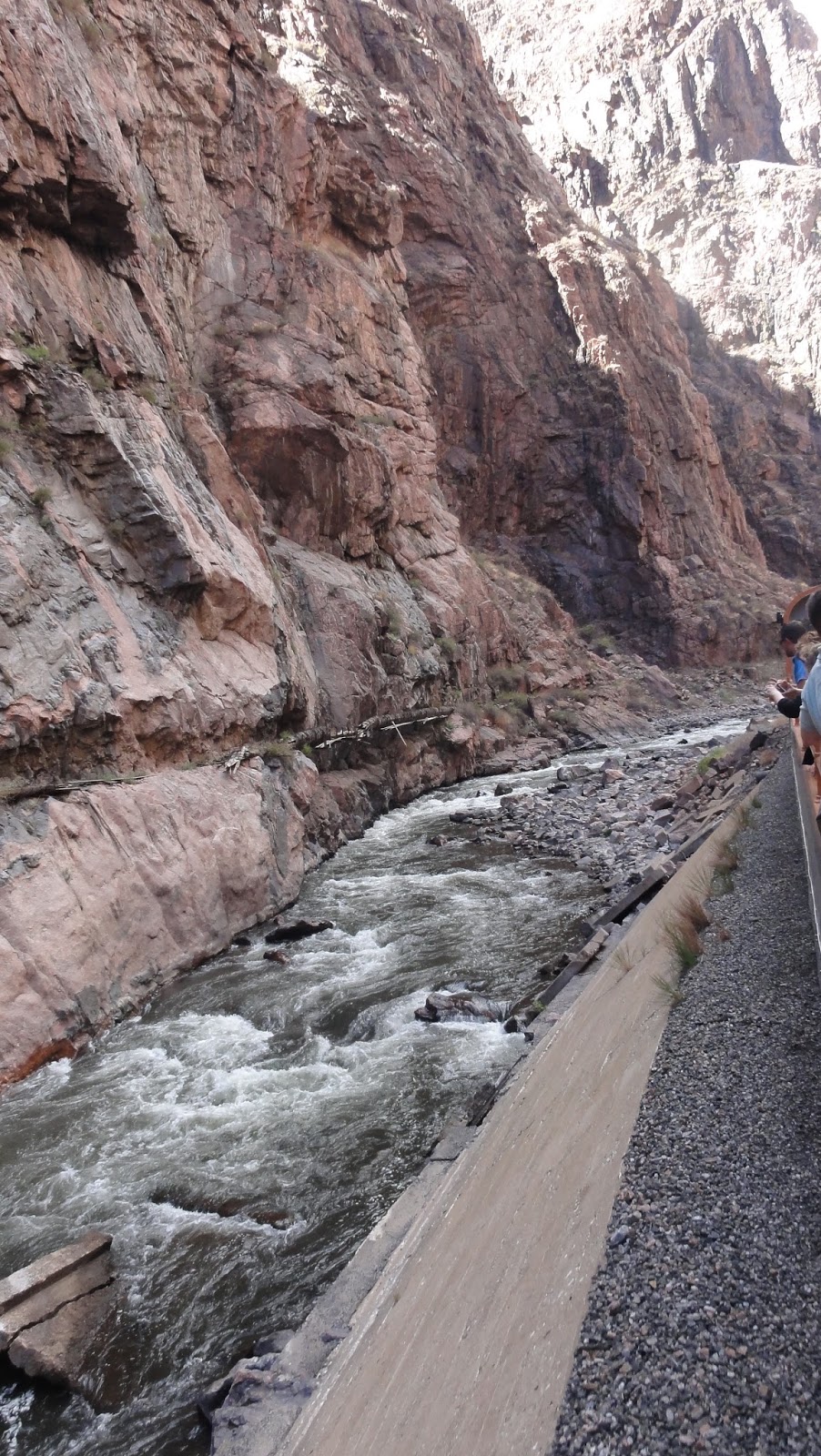
That is the 1882 name for what is now known as the Royal Gorge.  Today, we took a train ride up through the canyon to get some photos as it hit me that people who are not from here might want to see what the Colonist saw when they left Canon City heading west to Cotopaxi.

Remember that the train stopped every 7 -10 miles to fill up with water and every 25 miles to add coal.  Since it's 35 miles to Cotopaxi it took awhile for them to get there.

I decided to take photos showing todays train so you could get an aspect as to size and distance.  This is what it looks like when you leave town.  These water diversion gates were not there in 1882....but the landscape was the same and the lack of trees probably the same.


As you round the first couple of corners, you start to see a few more peaks.


Then the river gets more narrow as the peaks get taller


This is the first glimpse of the suspension bridge at the top - you can barely see it, but you can get an idea as to how flat and sheer some of the cliffs in the canyon are.


I wonder what the Colonists thought?  They must have been overwhelmed at the depth of this canon. Of course, the bridge was not there.  And they would have been on a narrow gauge train.  A much different experience than today's ride.


These days, some of the river walls have been cemented in due to floods and erosion of the ground under the tracks.  On the left is a water pipeline that did not exist in 1882.


This photo shows the jaggedness of the peaks going through the canyon.


And this is pretty much the scenery anywhere there is land you could walk on.  Filled with cactus and small shrubs.  Hard to believe this is just a few feet from the river, yet absolutely nothing grows here.


The train stops at Parkdale and then you come back to Canon City.   From Parkdale, the highway follows the train the rest of the way to Cotopaxi.  But if you drive it today, you just will not see what they saw going through the Royal Gorge.

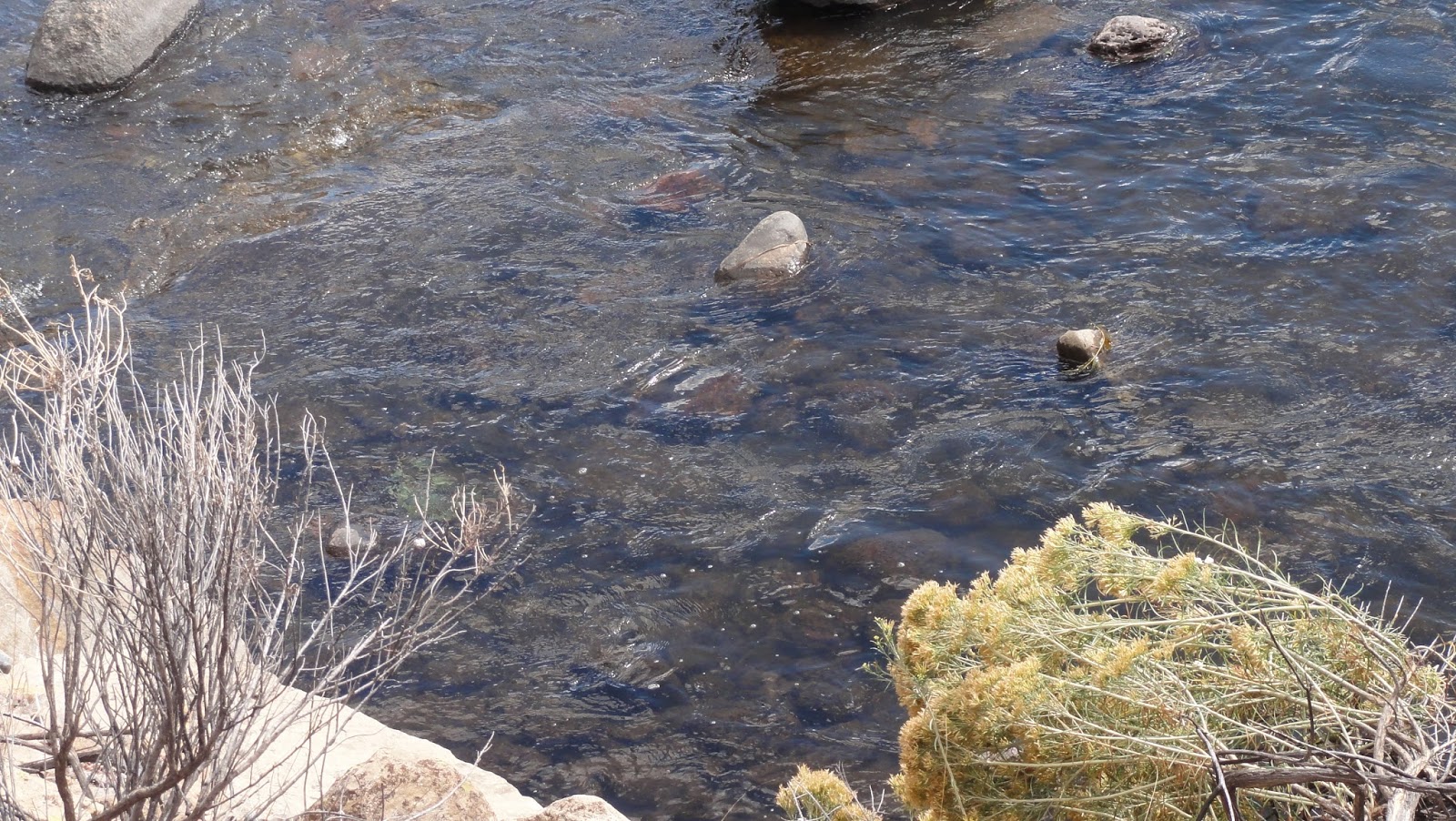
 I was able to get this shot of the water showing how shallow it is.  


Today, rafting is the main industry of this river.  But in the 1880s, logs were cut and then put in the river and floated downstream to Canon City and Pueblo.  This is at Parkdale where the early pioneers ran up to 5000 head of cattle and they crossed the Arkansas here.  That would have been something to see!


On the way back, I was able to get this closeup of the suspensions that support the train tracks through the narrowest part of the canyon.


They were told that they could farm the land and then they saw this.  I just think they had to have shook their heads in wonder!  I do and it's 2016!


*********c2016Cotopaxi-Colony.blogspot.com All content is copyright protected and may not be copied, reproduced, reused or reposted in any manner without permission.

Friday, September 30, 2016

New article on Cotopaxi out today

click here

Released today in the Intermountain Jewish News in the L'Chaim magazine.

An interesting perspective - asking the public to be a jury.  Yet fairly accurate.

He misquoted the website:

cotopaxi-colony.com belongs to Nelson and you will not find the articles there.  You will find his research and his commentary, not mine.

cotopaxi-colony.blogspot.com is this blog where the articles are.  Just look at the home page, down the right side and you will see links to all of the articles I have posted thus far.  (taking a short break and will get back to this in a week or so).

I do not believe I said Saltiel was "guilty as sin" - perhaps "guilty as charged"?  I know I made it clear that I have not and never would call Saltiel a "villain".   And it is not my belief that we are allowed to judge another human.  But we can show the known facts about a situation.  I think the author is attempting to do that here.  Yet much has been omitted that I would definitely want to present to a jury!

I think the greater question is whether this is a "jury" issue?  I still contend that Saltiel simply wasn't in Cotopaxi very much.    And I think the peripheral story is what matters....the fact that Saltiel had just gotten a divorce, married another woman, had small children, was still traveling to NYC and other places, was in court, in jail, dealing with mine transactions and simply not present much when the Colonists were there.

And since the findings are not complete - the story cannot be complete!  Thus the jury cannot convene and the judgement cannot be made.

Ask yourself how you might read this differently if the writer has presented me, representing the Colonists as the defendant?  After all, I suppose my research is to defend the oral histories handed down by the Colonists families.  And that would make the "bounty" side the prosecution....attempting to prosecute the Colonist for their oral histories.  Now that could have been an equally interesting story!

I had to chuckle that I am being portrayed as the prosecution.  There has been no criminal charge made against Saltiel.  I am not attempting to prove anything about Saltiel.  And I do think that's made clear in the article - I'm working to prove the accuracy of oral histories and the facts of what happened.

Yet, overall, a rather interesting take on the story.  What did you think?

I know....you think I need to skip life, finish my research, and get this written down!  OK....next week!  Unless life gets in my way.  :)


*********c2016Cotopaxi-Colony.blogspot.com All content is copyright protected and may not be copied, reproduced, reused or reposted in any manner without permission.

Thursday, August 18, 2016

Where was it notarized?


I have been doing genealogy research for years.  I have never bothered to look at the location where a document was notarized!  I think I always assumed the notarization took place where the event occurred!

Sometimes - it can change a story!

For Cotopaxi, we know that Elizabeth Saltiel joined her husband there sometime before the 1880 census was taken.  Oral history claims that she had an affair with the local postmaster, Frank Wood.

Documents tell us that he was the postmaster from May 25, 1880 until July 29, 1880.  And as far as the recorded documents go, he was the first postmaster in Cotopaxi.

On May 10, 1880, Frank Wood sold the Iron Arrow Lode to Emanuel Saltiel.

On June 19, 1880, Emanuel Saltiel created the Colorado Coal & Iron Co - which included the Iron Arrow Lode.

Jan 10, 1881, Frank Wood files a surety bond that is witnessed by Emanual Saltiel and A. C. McCoy

Mar 5, 1881, Frank Wood filed an affidavit of labor on the Cotopaxi Placer Mining Co.

And thus ends the records of Frank Wood in Cotopaxi.

I was reading through some of the other documents and found one dated April 21, 1881 between Elizabeth Saltiel and Charles Lamborn.  It was notarized in New York City.

So now we have evidence that she had left Cotopaxi and was residing in NYC as early as April 1881.

I had always believed that she and her children were living in Cotopaxi in May 1882 when the Colonists arrived.....obviously that was not true.

Next, I went back through all the transactions I have with her name on it.  The most recent was Dec 6, 1880, and it was notarized in Fremont County.  So she relocated to NYC sometime between Dec 1880 and Apr 1881.

Interesting what you can learn by looking at where and when a document was notarized.


*********c2016Cotopaxi-Colony.blogspot.com All content is copyright protected and may not be copied, reproduced, reused or reposted in any manner without permission.

Monday, July 18, 2016

Nov 17, 1882 letter from HEAS to Jewish Messenger on Schwartz report.

I thought I was posting in date order, but I found a couple more articles stashed in my files.  This one is from an unknown author, published in the Jewish Messenger, Nov 17, 1882.  From the content, though, it appears this was someone from the Hebrew Emigrant Aid Society in NYC.

The Jewish Messenger1882 Nov 17p 2, c 3
The Russian Emigrants
There was quite a large attendance of Directors of the Aid Society, at the regular meeting held on Monday evening, and an amount of Important business was transacted.  Mr. Edward Lanterbach presented an interesting report of his action while in Europe, representing the Society, and at its conclusion, the following was adopted:
“Resolved, That the thanks of this Society are due and hereby tendered to our worthy colleague, Mr. Edward Lauterbach, for the kind and valuable services he has rendered us during his presence in Europe, not only by representing us at the different aid societies, and vindicating our past course, but also by advocating our cause at the Vienna Convention, and procuring for us Important financial aid, whereby this society has been enabled to carry on its labors.”
Various communications were received and acted upon, among others one from the officers of the United Hebrew Charities, expressing their willingness to cooperate with the society in the work of providing relief to the Russian refugees, in the city.  Mr. E. S. Hart of the Cotopaxi Colony, submitted a flattering and encouraging report of its conditions, stating that the males are earning from two to three dollars a day, and the entire number of colonists are happy and contented, and in good health.
We have not found this report from E. S. Hart.  It would have been written to HEAS prior to November 1882...so before the first crop failed.  If you recall, Hart, and Ashkenazi Jew as the colonists were, owned the store at Cotopaxi.  He was a 1st cousin, once removed to E. H. Saltiel, a Sephardic Jew who owned/controlled the mines at Cotopaxi.
The number of refugees on Ward’s Island are gradually being reduced in number, mainly by distribution among the various colonies, under the management of the society.  There are now between five and six hundred persons on the Island, and peace and harmony on the whole prevails.  All the children are to be sent to the school maintained by the City on the Island, and applications wil be made to the Board of Education, for additional teachers. 
Mr. Julius Schwarz has prepared a detailed and comprehensive report of the Cotopaxi Colony, in which he pays the following compliments to the good qualities of the refugees:
“Your folks are first-class workers,” that is what I was pleased to hear about the laboring capacities our our people.  There is no doubt that the refugees have shown that they are not the lazy mob for which they were taken.  Under favorable circumstances they have done more than could have been expected.  Only one who knows what it means to break up virgin ground with a common shovel, can appreciate the industrious efforts of the refugees.  They have broken up the ground with a shovel, they have done the hardest part of the work required to make a wagon bridge; they have filled the ditches with rocks, which they have been compelled to cut and hew from the mountains; they went up to their throats in the swift Arkansas River, to make a foot bridge, to enable them to reach their lands; they worked in dark, damp mines, as good and as perserveringly as trained miners; they worked on the railroad giving entire satisfaction to their employers; they carried lumber on their shoulders, to spread the erection of their houses; they walked often twenty miles a day to chop wood in the forests for the purpose of putting fence posts around their farms.
This report can be seen here , and then the following 2 posts as it is in 3 parts.

They left out several paragraphs of the original report, but continue here:
Where these are facts, no theories are needed.  The argument of facts conjuers all other arguments.   The facts are, that the Colony in Cotopaxi is a success, the facts are, that those who advocated the idea that a Hebrew cannot make a farmer, have been refuted   They brought forward opinions, weapons of eloquences and of phrases, which we encounter with the weapons of facts  Facts speak.  Sixty Russian refugees left New York as paupers, five months ago.  Today they are self-supporting citizens.  They had been colonized, thus they became self-supporting; that is the logic of facts.  Do not spend lavishly your money for the purpose of distributing it to a desperate mob—-the mob will ever remain a mob—even if you give each individual the amount he gets now.  The system of money distribution mitigates the pains of the wounds, but does not heal the wound.  Colonize them, give them land, settle them, give them a home, and the mob will become a class of peaceful citizens, who love the spot to which their faith has tied them.  There is a great and sublime principle in colonization.  The principle of the qualification of Judaism.  There never was a better opportunity to show the never dying perseverance of the Jewish race, never a better chance to prove to the world that agriculture is not adverse to the Jewish feelings and inclinations, whereby can be utilized the ? power of the soil.  Distribute money, spend thousands of dollars for supplying daily wants, and you will breed and raise paupers and beggars; colonize and you will make self-supporting men.
All of this is a copy of the Schwartz report.
No author listed
This would be our evidence that HEAS had a copy of the Schwartz report by at least November, 1882.  


*********c2016Cotopaxi-Colony.blogspot.com All content is copyright protected and may not be copied, reproduced, reused or reposted in any manner without permission.

March 10, 1883, the Phillip Nussbaum letter

This is a letter that Philip Nussbaum wrote to the American Israelite.  He lived in Pennsylvania and had been in Colorado in December 1882 and had visited Cotopaxi.

Letter to Editor from Philip NussbaumSent 10 March 1883 Published on 23 March 1883 in the American Israelite
To the Editor of The American Israelite
In December last I was sojourning in Colorado, and while in those parts, visited Cotopaxi with a view of personally investigating how our brethren were faring in their newly-made homes. As anticipated, I found the colonists enjoying the best of health, as the Cotopaxi climate is very salubrious, notwithstanding the expressed opinion of the Denver committee to the contrary.
He must have arrived by train.  How long did he stay?
A long residence in Colorado and some ten years of experience as a stock-raiser, justify me in the above contradiction, as I am very well acquainted with the entire mountain range, climate and soil all around Cotopaxi, clear to Fairplay and the Snowy Range, and have grazed my stock during the summer and early fall in very close proximity to Cotopaxi, but was compelled to drive my herd to the valley in November.
During the entire time of my abode in those parts we have had splendid summer pastures, but grazing alone was profitable and not farming, as the season for the latter are entirely too short, extending from June only to September, and under those circumstances, aside of being a rocky, mountainous range, what colony, even if most completely equipped (which this is far from), could succeed in making a living and supporting its families?
Here he explains the difference between cattle ranching and farming.  Cattle could succeed, farming could not.  He also confirms that the farmers were far from being equipped.
I am satisfied the H.E.A.S. would never have had the remotest idea of planting a colony in that barren country had it not been for the instigation of Mr. E.H. Saltael whose object the circumstances only too plainly demonstrate, and he alone is to blame and is responsible for the unsuccessful issue of the Cotopaxi Colony, and not the H.E.A.S., who have done everything in their power for the promotion and welfare of the unfortunate emigrants, and they (the colonists) are aware of it and are thankful and ever praying for the good health and long life of its committee.
Additional evidence that Saltiel did not provide for the Colonists.  A witness.
Had not the high-flavored, or, as Mr. Henry called it, “rose-colored” report of Mr. Julius Schwartz, LL.D., appeared, no trouble would have been known and no Denver committee needed.
Although adding the no doubt deserved LL.D. to his name, he does not possess good, sound judgment, but, on the contrary, manifests his inexperience and downright ignorance of the requisites of a new colony, peopled by strange people in a strange land, by forwarding a report to the easily beguiled committee (who have reposed all confidence in him) that there was nothing left undone and that the colony was in a very flourishing condition. Although at the time the report was made (I believe in August) everything looked brighter. The crop, if such it can be called, consisting solely of potatoes, was in the ground, yet, nevertheless, J.S., LL.D., brought his great imaginary powers, “Col. Sellers”-like, to his aid, supported by his mathematical abilities, and calculated upon a realization of at least two thousand dollars from the crop, which only goes to show that he had as much knowledge of the fall and winter climate as he did of the potatoes. His calculation went wide of its mark, and the unfortunate emigrants in course of time found out the true state of affairs, but, of course, as is usually the case, after the barn door having been left open, and instead of having potatoes to sell, they found themselves compelled to buy, and were willing to work outside of the colony to meet their daily wants, but only a few succeeded in obtaining work.
Confirmation of my prior posting that Schwarz's math calculations were inaccurate.  And possible confirmation that the Schwarz report was written in August, but not published until October?
This state of affairs they communicated to some of the committee, but could get no reply; they wrote again and again, but no answer was sent them.
It was plainly seen from the President’s (Mr. Henry) report to the Denver Committee that he imagined the colonists well supplied, and that they from choice alone preferred begging for charity. 
Now in the name of humanity and common sense, what could the poor emigrants do? Reply from New York was denied them (as you can see by the letter they wrote to me), work to keep body and soul together they could not obtain; they had no alternative but to lay their very lamentable condition before the Denver Jews.
The Denverites sent a committee Metaglem out to them, and they, in return reported wrongly and greatly misrepresented and exaggerated the matter, and in fact caused more real harm than good to the poor colonists. The ignorance displayed in reporting that a house sixteen by twenty, doubly boarded, etc., costs only, together with stove and cooking utensils, one hundred dollars, is perfectly absurd. I have seen the houses and have been in them, and have the figures of a carpenter. It takes just thirty-five hundred feet of lumber to build the house and partitions, etc., but should not cost over one hundred and fifty dollars, not including any utensils – but there is no use in crying over spilt milk now.
Direct conflict of the report that said the house would require 5000 board feet.

The houses are comfortable enough for eight or nine months of the year, but in the dead of winter no one cookstove can keep them warm, and they have no other.
This is the first time we have heard that they needed more than the cooking stove to keep them warm in winter.  Daytime temperatures can drop to below zero, and a house made of 2 slat boards with tar paper between them, and no insulation, could easily need more than a kitchen cook stove.
They have plenty of wood, not a great distance off, but have to hire it hauled, as they have only one span of horses on a farm of twelve miles.
Today it takes 2 cord of wood to heat a well heated home during the winter in Canon City.  How much wood did they have to hire hauled?
In conclusion, I will say that the emigrants of Cotopaxi are a set of hard-working, industrious people, with good manners and behavior, and are willing to work, as work is what they want and not schnorring. But work they cannot obtain in that forsaken spot, winter is hard upon them, and burdened with families, what can they do but beg or wait until everything is exhausted and starve to death with their families?
By that first winter, the train work would have been gone, no "construction" during the snow season.  Work in the mines?  There was no other industry in Cotopaxi at that time.
Had the colony been planted on a reasonably good tract of farming land where the change for the display of sinew and muscle could have been had, I assure you your committee would have been spared all this superfluous aggravation and trouble, and the emigrants would have been on a fair way to prosperity and happiness.
But, nevertheless, this misstep must not, and shall not dishearten this most praiseworthy H. E. A. S. of the United States, as all beginnings are difficult, but so much more gratifying is the reward.
The moral this high-priced lesson has taught them, is not to take every one’s word for selecting a location to plant a colony.
Probably the best advice yet.
The selection requires a great deal of judgment and good common sense, and, furthermore, an eye for the future and not greed for personal fame and gain, but to put heart, hand and mind in concert to aid our unfortunate brethren to a future state of prosperity and happiness.
I am of the opinion that a great deal of good may arise out of this controversy, as an exchange of views as to the best plan of planting colonies is the proper question to arrive at now.
In my opinion, timber-land in close proximity to a river would be the most suitable place, where an opportunity for improvement and display of energy could be had, and I would kindly request our co-religionists who have this matter at heart to express their views upon it and let us all have the benefit of it.
Yours respectfully,
Ph. Nussbaum.
Bradford, Pa.
March 10, 1883
A little more research and I found that Philip Nussbaum was born in 1830 in Russia.  He was living in Bradford PA in the 1880 census.  He was a grocery merchant, married to Pauline, and his children were Celia, 19, Louis, 23, Benjamin, 21, Mary, 17, and Rebecca, 14.  From the 1900 census, we learn that he immigrated to this country about 1853.

In the 1870 census, he lived in the Colorado Territory, in Pueblo and is listed as a stock dealer.  In the 1860 census, he lived in Dunkirk, NY, and was a peddler.  He died 13 Jun 1970 in Bradford PA.


*********c2016Cotopaxi-Colony.blogspot.com All content is copyright protected and may not be copied, reproduced, reused or reposted in any manner without permission.