I will be giving my presentation "The Jewish Colony at Cotopaxi" this Saturday, Feb 27, at 1 pm in the back room at Design Ur Memories, 518 Main Street, Canon City
This is the presentation that I will be doing next month in Gush Etzion, Judea, Israel. This is going to be from a historical perspective rather than a genealogical view. I plan to cover these issues:
The Cotopaxi area in the late 1800s
Why the Jews wanted to leave Russia
How Emanual Saltiel got involved, what he promised to do, what he didn't do and why.
The past written records and new findings.
The 3 weddings.
The miner's lien.
Saltiel's hotel and who he was.
The cemetery, the records and the road marker.
Those are a few of the things I have been asked to research in the past.
Sorry, this will not be recorded as this is my trial run for the Israeli presentation and I will allow questions at any time during the presentation just so I know what to fix for next month!
If you live in Colorado, I hope you can come. There are chairs for about 20 people but there's always room to sit on the floor!
Showing posts with label Cotopaxi CO. Show all posts
Showing posts with label Cotopaxi CO. Show all posts
Monday, February 20, 2017

Saturday, October 8, 2016
More on the Nudelman house
Back in February, I posted a blog about the Nudelman house - from the standpoint that several documents had been tossed into the trash and then found their way to the local History center.
I've been researching it ever since. I'd like to verify the location of the house today - if it still exists.
First, that original document found in the trash:


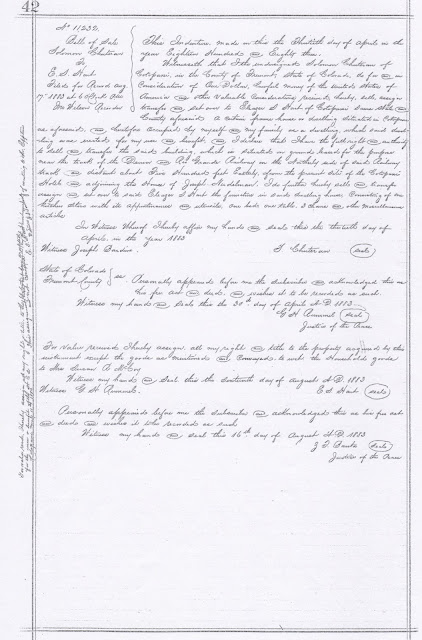
The typed version of the Chuteran document:
*********c2016Cotopaxi-Colony.blogspot.com All content is copyright protected and may not be copied, reproduced, reused or reposted in any manner without permission.
I've been researching it ever since. I'd like to verify the location of the house today - if it still exists.
First, that original document found in the trash:


Another document that was pulled from the trash is the sale of the other half of the house, the Chuteran property, the same day. Interesting that this document was just one page.

11232
Bill of Sale
Solomon Chuteran to
W. S. Hart
Filed for Record Aug 7, 1883 at 6 o’clock pm
Jno Wilson Recorder
This indenture made on this the Thirtieth day of April in the year Eighteen Hundred and Eighty three.
Witnesseth that I the undersigned Solomon Chuteran of Cotopaxi, in the County of Fremont, state of Colorado, do for and inconsideration of One Dollar, lawful money of the United States of America and other valuable consideration received hereby, sell, assign, transfer and set over to Eleazer S. Hart of Cotopaxi, same state and county aforesaid a certain frame house or dwelling situated in Cotopaxi as aforesaid, and heretofore occupied by myself and my family as a dwelling which said dwelling was erected for my use and benefit and I delcare that I have the full right and authority to sell and transfer the said building, which is situated on grounds leased for the purpose near the track of the Denver and Rio Grande Railway on the northerly side of said railway track and distant about five hundred feet easterly, from the present site of the Cotopaxi Hotel and adjoining the House of Joseph Nudelman. I do further hereby sell and transfer assign and set over to said Eleazer S. Hart the furniture in said dwelling house, consisting of one kitchen stove with appurtenances and utensils, one bed, one table, 3 chairs and other miscellaneous articles.
In witness whereof I hereby affix my hand and seal this the thirtieth day of April, in the year 1883.
S. Chuteran
Witness Joseph Bardine
State of Colorado
Fremont County ss
Personally appeared before me the subscriber and acknowledged this as his free act and deeds, and wishes it to be recorded as such. Witness my ahdn and seal this the 30th day of April A. D. 1883. G. H. Rummel seal, Justice of the Peace
For value received I hereby assign all of my right and title to the property acquired by this instrument except the goods as mentioned and conveyed to with the household goods to Mrs Susan A McCoy.
Witness my hand and seal this the sixteenth day of August A. D. 1883 E. S. Hart, seal, Witness G. H. Rummel.
Personally appeared before me the subscriber and acknowledged this as his free act and deeds and wishes it to be recorded as such. Witness my hand and seal this 16th day of August A. D. 1883. Z. T. Banta seal, Justice of the Peace.
Down the left side of the page:
For value received I hereby assign all my right and title to the property acquired by this instrument of writing to Mr Epptein. This assignment has not been accepted, has not been conveyed. E. S. Hart, witness H. S. Tooling.
I have not been able to locate all of the documents that I am looking for but I do have some that refer to this as the "McCoy double house". As soon as I have a complete "trail" I will come back and update this post. But it appears that this was 2 families living under a common roof with a wall adjoining their residences...the houses were attached to each other.
It is also evident that the houses were built on land leased from E. H. Saltiel.
In my later documents, the land was sold by O. B. Carroll to A. A Sloan. Then Sloan sold the double house and the land to W. A. Hendricks. Hendricks sold it back to Sloan who sold it to Kate Gorman in 1895. I do not have documentation yet as to how it got to Carroll from McCoy.....or who it went to after Gorman.
Couldn't I just to a title search? No - that won't work for most of the houses in Cotopaxi. For most of the houses, sometime between 1910 and 1950...the owners all went to court to prove their ownership. And by doing such, they didn't have to go back and verify the earliest ownerships. They would stand on the court house steps in Canon City and literally call out every possible owner's name. No one showed up and the judge awarded the property to the current owner.
That or they simply had it re-declared under the Federal Land act.
And yes, this may be wasting my time, but I have to wonder. With these 2 documents are "new" questions.
1) Were the Nudelmans and the Chuterans related? People rarely lived this close together if they weren't.
2) Did both of these families leave Cotopaxi in April, 1883, when the houses were sold? Or had they built another house on the land they farmed that was south of Cotopaxi?
I have found no documents showing the sale of any of the plots south of Cotopaxi.
3) In both documents, the property was "sold" to E. S. Hart who then "sold" them to Susan McCoy. Was Hart acting as an early realtor in western Fremont county?
4) It does not appear that the furniture was transferred to McCoy.
5) This does tell us some of the furniture they had.
6) The sale was for $1 and "other valuable considerations." This is a common phrase used and could mean anything. Did they just want to dump the property? Was it worth nothing since they didn't own the land it was on. What would a 49 year lease be worth? How much would you give for a duplex that sat on a 49 year lease and you didn't know if the lease could be renewed or not?
7) Who did McCoy sell the place to?
Interesting questions!
One thing I do know is that neither Nudelman or Chuteran were listed on the miner's lien. It would be doubtful that Saltiel paid them and not the others. Thus, most likely, they did not owe Hart any money at his store.
These documents also show us that:
Joseph Bardine was a witness
G. H.. Rummel was the Justice of the Peace
Z. T. Banta was a justice of the Peace
and there was a Mr. Epptein
and a witness H. S. Tooling.
What were their relationships with the Colonists? with Saltiel? with Hart?
This is a prime example of how researching local documents can give you clues as to where to go next with your research, whether it is related to your family tree or not.
*********c2016Cotopaxi-Colony.blogspot.com All content is copyright protected and may not be copied, reproduced, reused or reposted in any manner without permission.
Saturday, October 1, 2016
The Grand Canyon of the Arkansas
That is the 1882 name for what is now known as the Royal Gorge. Today, we took a train ride up through the canyon to get some photos as it hit me that people who are not from here might want to see what the Colonist saw when they left Canon City heading west to Cotopaxi.
Remember that the train stopped every 7 -10 miles to fill up with water and every 25 miles to add coal. Since it's 35 miles to Cotopaxi it took awhile for them to get there.
I decided to take photos showing todays train so you could get an aspect as to size and distance. This is what it looks like when you leave town. These water diversion gates were not there in 1882....but the landscape was the same and the lack of trees probably the same.


These days, some of the river walls have been cemented in due to floods and erosion of the ground under the tracks. On the left is a water pipeline that did not exist in 1882.


They were told that they could farm the land and then they saw this. I just think they had to have shook their heads in wonder! I do and it's 2016!

*********c2016Cotopaxi-Colony.blogspot.com All content is copyright protected and may not be copied, reproduced, reused or reposted in any manner without permission.
Remember that the train stopped every 7 -10 miles to fill up with water and every 25 miles to add coal. Since it's 35 miles to Cotopaxi it took awhile for them to get there.
I decided to take photos showing todays train so you could get an aspect as to size and distance. This is what it looks like when you leave town. These water diversion gates were not there in 1882....but the landscape was the same and the lack of trees probably the same.

As you round the first couple of corners, you start to see a few more peaks.

Then the river gets more narrow as the peaks get taller

This is the first glimpse of the suspension bridge at the top - you can barely see it, but you can get an idea as to how flat and sheer some of the cliffs in the canyon are.

I wonder what the Colonists thought? They must have been overwhelmed at the depth of this canon. Of course, the bridge was not there. And they would have been on a narrow gauge train. A much different experience than today's ride.

These days, some of the river walls have been cemented in due to floods and erosion of the ground under the tracks. On the left is a water pipeline that did not exist in 1882.
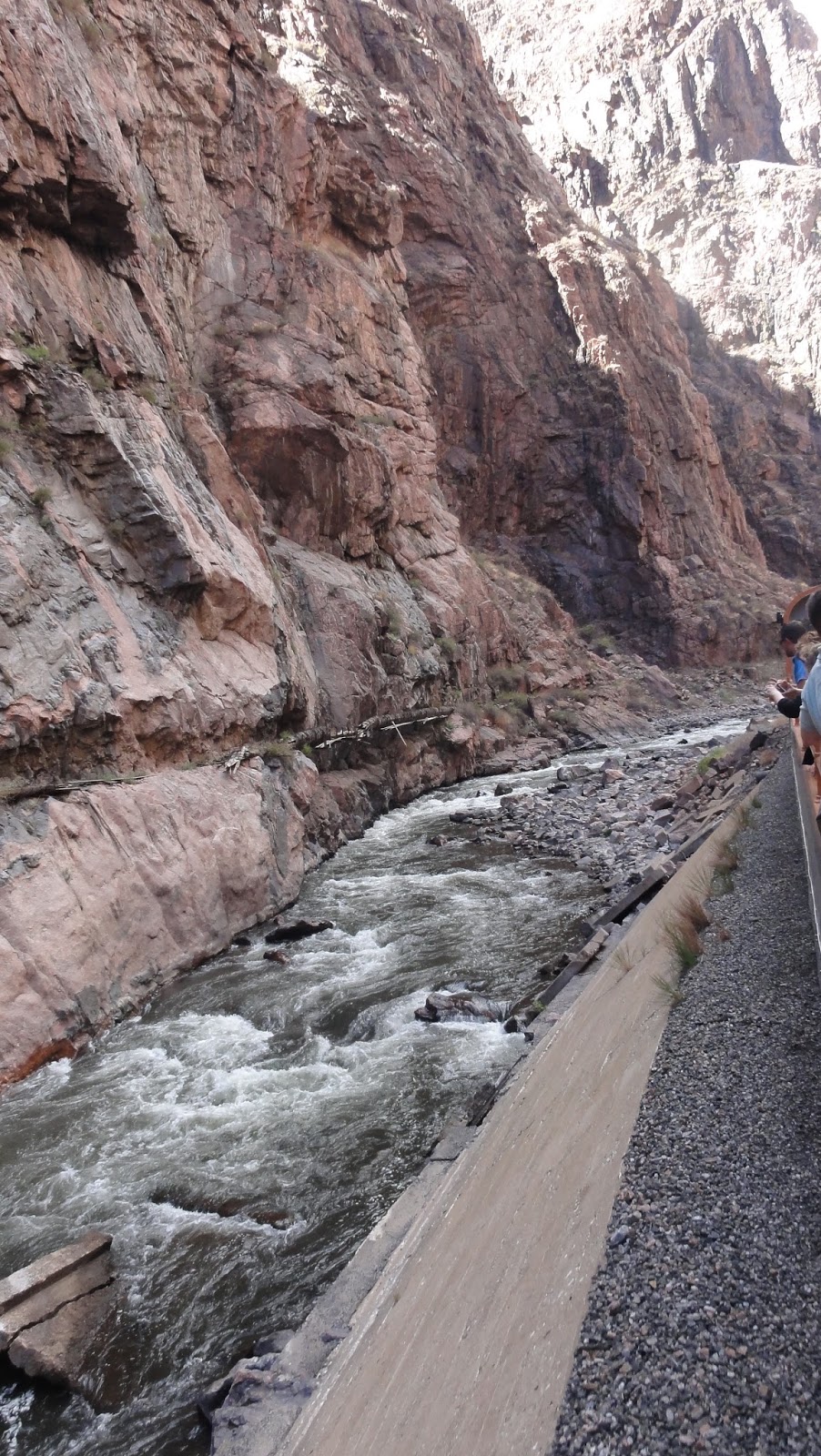
This photo shows the jaggedness of the peaks going through the canyon.

And this is pretty much the scenery anywhere there is land you could walk on. Filled with cactus and small shrubs. Hard to believe this is just a few feet from the river, yet absolutely nothing grows here.

The train stops at Parkdale and then you come back to Canon City. From Parkdale, the highway follows the train the rest of the way to Cotopaxi. But if you drive it today, you just will not see what they saw going through the Royal Gorge.
I was able to get this shot of the water showing how shallow it is.
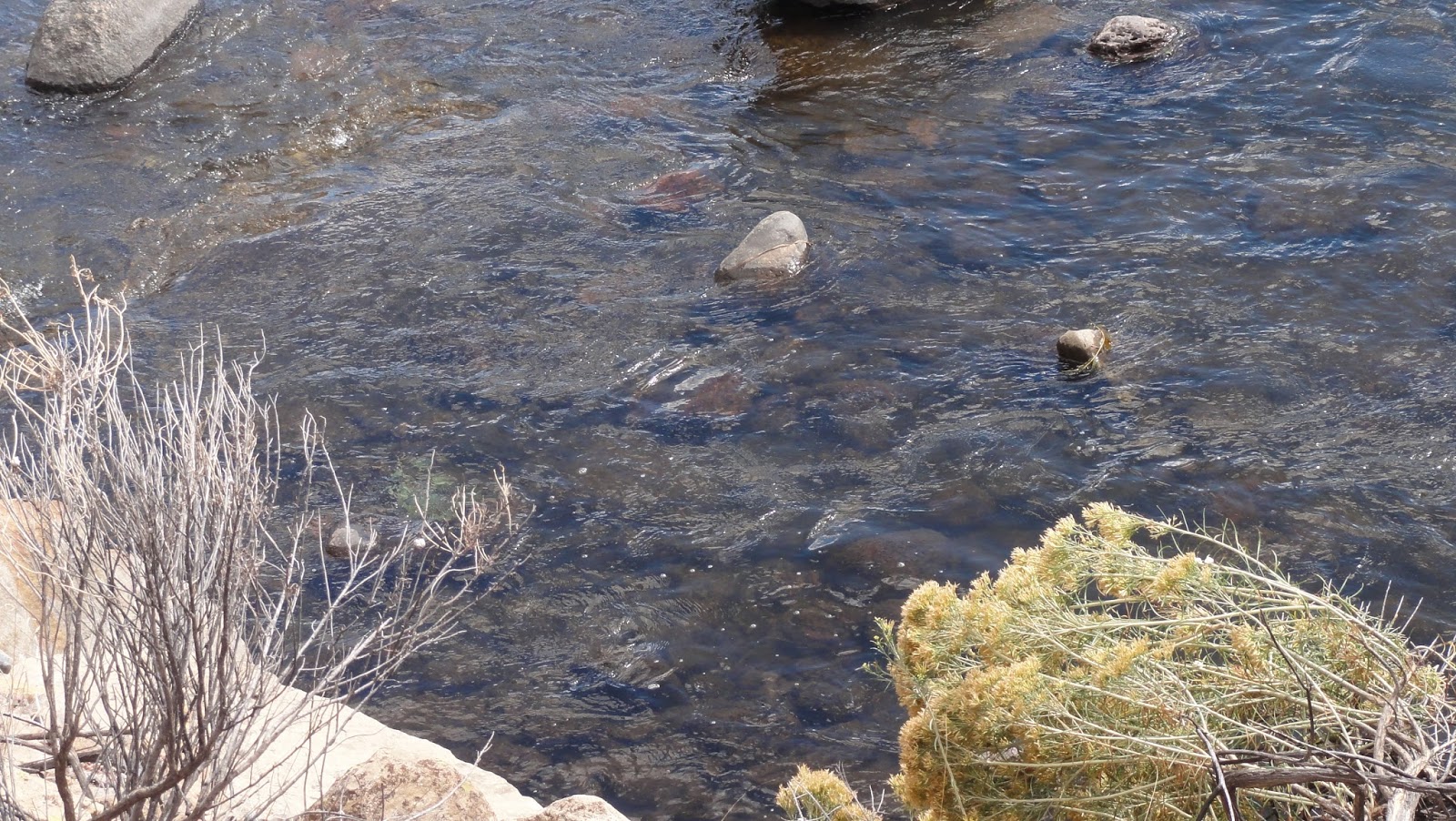
Today, rafting is the main industry of this river. But in the 1880s, logs were cut and then put in the river and floated downstream to Canon City and Pueblo. This is at Parkdale where the early pioneers ran up to 5000 head of cattle and they crossed the Arkansas here. That would have been something to see!

On the way back, I was able to get this closeup of the suspensions that support the train tracks through the narrowest part of the canyon.

They were told that they could farm the land and then they saw this. I just think they had to have shook their heads in wonder! I do and it's 2016!

*********c2016Cotopaxi-Colony.blogspot.com All content is copyright protected and may not be copied, reproduced, reused or reposted in any manner without permission.
Thursday, August 18, 2016
Where was it notarized?
I have been doing genealogy research for years. I have never bothered to look at the location where a document was notarized! I think I always assumed the notarization took place where the event occurred!
Sometimes - it can change a story!
For Cotopaxi, we know that Elizabeth Saltiel joined her husband there sometime before the 1880 census was taken. Oral history claims that she had an affair with the local postmaster, Frank Wood.
Documents tell us that he was the postmaster from May 25, 1880 until July 29, 1880. And as far as the recorded documents go, he was the first postmaster in Cotopaxi.
On May 10, 1880, Frank Wood sold the Iron Arrow Lode to Emanuel Saltiel.
On June 19, 1880, Emanuel Saltiel created the Colorado Coal & Iron Co - which included the Iron Arrow Lode.
Jan 10, 1881, Frank Wood files a surety bond that is witnessed by Emanual Saltiel and A. C. McCoy
Mar 5, 1881, Frank Wood filed an affidavit of labor on the Cotopaxi Placer Mining Co.
And thus ends the records of Frank Wood in Cotopaxi.
I was reading through some of the other documents and found one dated April 21, 1881 between Elizabeth Saltiel and Charles Lamborn. It was notarized in New York City.
So now we have evidence that she had left Cotopaxi and was residing in NYC as early as April 1881.
I had always believed that she and her children were living in Cotopaxi in May 1882 when the Colonists arrived.....obviously that was not true.
Next, I went back through all the transactions I have with her name on it. The most recent was Dec 6, 1880, and it was notarized in Fremont County. So she relocated to NYC sometime between Dec 1880 and Apr 1881.
Interesting what you can learn by looking at where and when a document was notarized.
*********c2016Cotopaxi-Colony.blogspot.com All content is copyright protected and may not be copied, reproduced, reused or reposted in any manner without permission.
Friday, August 5, 2016
"My mind's made up - don't confuse me with the facts!!"
I wrote about Esther Young before, but I need to re-write this to make some clarifications, add images, and show us that if we look for the documents, and use genealogy, we are able to show that facts can change what we think we knew in our minds!
If you visit the cemetery in Cotopaxi, be sure to look to the hill to the north of it. Yes, a completely separate hill with a small ravine between it and the cemetery, in fact, there's a road at the bottom. On that hill (to the north east), there is another grave. Nelson has it pretty well documented here:
Cotopaxi Cemetery - Ester L. Young
Why was she buried on a separate hill?

Her headstone:

Our Mother
Though out of sight to memory dear
Esther L. Young
born in Rutherford Co, Tenn
June 18, 1809
Died in Cotopaxi Colo
Dec 9 1898
Note it does spell her first name with an "h" - it is left out of some of the writings.
Local lore has it that she was a woman of color:
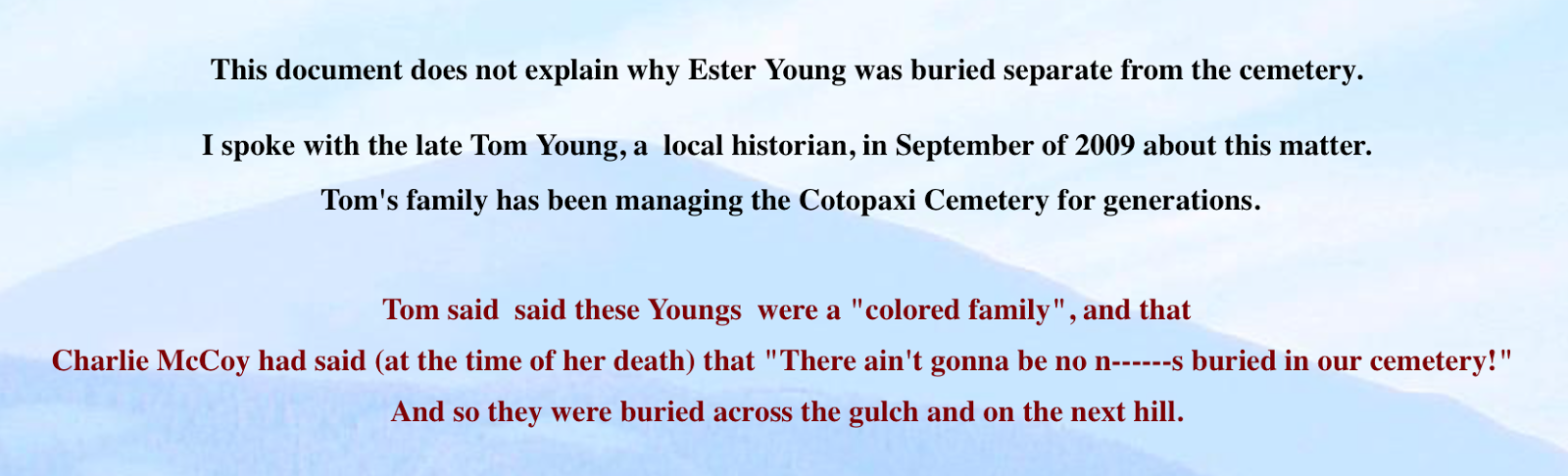
When I started my journey of creating family trees for the gentile families who were at Cotopaxi in the early days, I discovered who Esther L. Young really is! She is a caucasian woman! She was T. Witcher's grandmother-in-law. But what was her relationship to Charlie McCoy? And why would he make the above statement about her?
This is the family tree I was able to build from census records:
James B. Young, born 1800, married Esther Lamira Moore born 1809.
They had:
Alex Young b 1827
Sarah Young b 1834
Mary Young b 1842
Lamiar J Young b 1846
Sarah Young married Joseph Hardin and they had:
Mary Belle Hardin, b 1860
Willie Hardin b 1862
Mary Belle Hardin b 1860 married T Witcher b 1842 and they had
Otis W Witcher b 1881
going back to the first family of James B Young b 1800, married to Esther Lamire Moore born 1809, their daughter
Lamiar J Young b 1846 married Jeremiah D. Hylton b 1838 and they had
Thomas Hylton b 1868
Lucy Hylton b 1870
Mary Hylton b 1870
So, Esther L. Young, born 1809 was the grandmother-in-law to T. Witcher, the mother-in-law of J. D. Hylton, and the grandmother of Thomas Hylton.

We can then prove this with census records;
In the 1850 Census, Esther L. Young, widow, is living in Blue Township, Jackson County, MO. Her mother, Sarah Moore, is living with her family. Her children are Martha 20, Sarah 16, Mary 8, Lamira J. 4.
In the 1860 Census, Esther L. Young, widow, is living in Blue Township, Jackson County, MO, born in TN. Her children are Mary 18, Lamira 13
In the 1870 Census, Esther L. Young, widow, is living in Lees Summit, Jackson County, MO with Sarah Hardin who is now widowed, age 36. Sarah's children: Mary is 10 and William is 8.
In the 1880 Census, Precinct 5 of Fremont County: (Cotopaxi was Precinct 7 at that time)
Sarah Hardin, age 46
Lamira Young, age 70, (b 1810) mother
T. Witcher, age 37, son-in-law
Belle Witcher, age 20, daughter
Willie Hardin, age 18, son

Therefore, Esther Lamire Young was now known as Lamira Young (her daughter Lamiar J. Young would have been known as Lamiar J. Hylton).
T. Witcher was living with his mother-in-law AND his grandmother-in-law!!
Did they love here so much that they gave her a separate burial ground with a wood picket fence around it? Go back and look at the headstone - "Our Mother Though out of sight to memory dear" She lived with her children - they must have loved her!
Her obituary in the Canon City newspaper:

Mrs. Lamira Young died at the home of her daughter, Mrs. L. J. Hylton, Cotopaxi, last Friday morning in the ninetieth year of her age. Mrs. Young was the sister of Rev. B. Frank Moore of this city. She leaves three children: Mrs. Sarah Hardin, this city; Mrs. M. C. Gelknap, Hillside, Colo. and Mrs. L. J. Hylton. She was born in Bedford co., Tenn, June 19, 1809. In 1831 she married Mr. William Stokes, who died in 1833; shortly after this she and her family moved to Missouri, where she married in 1840, Mr. James Young, who died in 1846.Mrs. Young crossed the plains seven times, making her home finally in this county, and the last year of her life with her daughter, Mrs. Hylton. She became a christian at the age of 12 years, uniting with the Cumberland Presbyterian church and faithfully served God for 77 years of her life. She was a noble woman, always ready to respond to a case of need; a true friend, who in her long life did the good that came to hand, with kindly word and hand ministering to all. The fragrance of her memory is sweet and she still lives in the influence of her beautiful example. Our loss is her gain, for she hath now entered into the glorious rest of the children of God, where we shall again meet her.The funeral services were celebrated by the Rev. W. J. Fisher, Pastor of the Cumberland Presbyterian church of Canon City, at Cotopaxi, Dec 10, 1898.She was a good woman.
So, how did Charlie McCoy come to make the statement that he did? Was he also related to her? Let's look at Charlie's family tree:

Charlie's sister, Minnie is married to Thomas Hylton. If you go back up to the Hylton tree above, you will see that Thomas Hylton is the son of Lamire Young Hylton.
Thus Charlie McCoy's sister is the granddaughter-in-law of Esther L. Young. And in such a tiny community, Charlie would have known her and known that this woman was caucasian! Did he start a rumor because he didn't like her? I'm not sure we will ever know, but it's something to keep researching.
Charley McCoy was born in 1860. He was 38 in 1898 when Esther L. Young died.
A little logic and reasoning here. If Esther L. Young was not caucasian, then her children and her grandchildren would not have been caucasian. That means Thomas Hylton would have been a colored man because he was her grandson. Yet he wasn't. Neither was his mother, Lamar Young Hylton.
In this family tree, I have connected the Youngs, McCoys, Hiltons, Witchers, Mullins, Hendricks and Carrolls. One big tree for sure!
And at this point - I believe we can change the oral histories to show that Esther L. Young was a caucasian woman - she was an honorable woman. I would go one step farther and state that she was most likely buried on a separate hillside because her children loved her so much, they wanted her separated out.
But if your mind is made up after 100+ years of oral history, don't let me confuse you with the facts!
*********c2016Cotopaxi-Colony.blogspot.com All content is copyright protected and may not be copied, reproduced, reused or reposted in any manner without permission.
Sunday, July 10, 2016
***making frequent updates at the bottom of this post*** The hazards of life in Western Fremont County
I thought I'd do a short blog post just so readers understand the weather in Cotopaxi this year. And then you can understand more about life there in 1882.
Friday, July 8, a small fire broke out on Hayden Creek. The reports are that it was a lightening strike. I have recently posted about the Shradsky property might have been located on the Hayden Creek Road, so this is just to the south west of Cotopaxi.
I made this map to give you a better idea. The blue areas are where the colony plots were. The red arrow is approximately where the fire is and the direction it is headed. Maybe 4 miles as the "crow flies".

This photo was taken by someone who lives in Cotopaxi just about an hour ago (Sunday, July 10, 4 pm), looking past the Cotopaxi School to the west. The fire has broken out. Flames are shooting 200' into the sky. It is blowing from the Southwest.


UPDATE July 14, 5:45 pm. They have been dropping water and fire retardant along the east side of the fire. While the middle is still burning, there is no growth to the east. Hopefully they can now keep it contained. The colony lands appear to be safe for now.
UPDATE July 16 5:15 am. Here is a decent website with photos: Pueblo Chieftain. The fire has consumed almost 16,000 acres. It is 5% contained. It will burn until October when the snows come. Residents that were evacuated will not have access for up to 2 more weeks. Over 600 firefighters working the fire today.
*********c2016Cotopaxi-Colony.blogspot.com All content is copyright protected and may not be copied, reproduced, reused or reposted in any manner without permission.
Friday, July 8, a small fire broke out on Hayden Creek. The reports are that it was a lightening strike. I have recently posted about the Shradsky property might have been located on the Hayden Creek Road, so this is just to the south west of Cotopaxi.
I made this map to give you a better idea. The blue areas are where the colony plots were. The red arrow is approximately where the fire is and the direction it is headed. Maybe 4 miles as the "crow flies".

This photo was taken by someone who lives in Cotopaxi just about an hour ago (Sunday, July 10, 4 pm), looking past the Cotopaxi School to the west. The fire has broken out. Flames are shooting 200' into the sky. It is blowing from the Southwest.


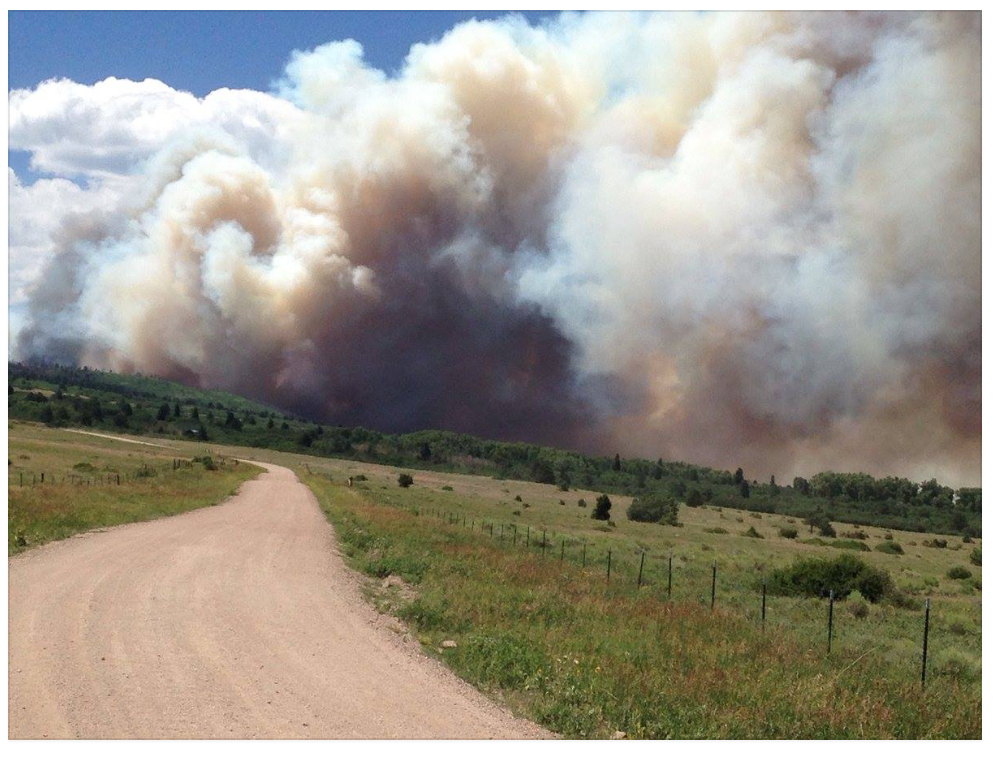
UPDATE July 14, 5:45 pm. They have been dropping water and fire retardant along the east side of the fire. While the middle is still burning, there is no growth to the east. Hopefully they can now keep it contained. The colony lands appear to be safe for now.
UPDATE July 16 5:15 am. Here is a decent website with photos: Pueblo Chieftain. The fire has consumed almost 16,000 acres. It is 5% contained. It will burn until October when the snows come. Residents that were evacuated will not have access for up to 2 more weeks. Over 600 firefighters working the fire today.
*********c2016Cotopaxi-Colony.blogspot.com All content is copyright protected and may not be copied, reproduced, reused or reposted in any manner without permission.
Friday, July 8, 2016
Julius Schwarz replies to the Kohn/Witkowski report
writing to H. S. Henry, the President of HEAS, this was posted in the American Hebrew the very same day as Mr. Henry's response to the report.
With all of the records, reports, writings that were made....HIAS claims today that there are no records. HEAS did close in June, 1883, and it is possible that all of their records were destroyed when they closed. HIAS is the present day agency.
I will say that in 3 hours in Cotopaxi - yes, you could make a determination. You could probably do it in a 20 minute interview with any of the Colonists. Considering that at this point, Ed Grimes had walked away from the colony, and that the Snyders/Menkowskys/Newmans had also all left - you could definitely make an assessment in 3 hours. Perhaps even more so by someone who had lived in Colorado for years and knew the weather, altitude, etc.
Remember, I am posting these documents in a chronological time order. It is fair to go back and forth between current documents and future documents. At the time of this writing, we did not know what the answers to some of these questions are. But it is possible that future documents will give us answers.
It is quite possible for a creek to be dry in the winter and contain no water by summer. Only in spring melt-off would there be water every year.
Re-confirmation that a bridge was sept away by a flood in the summer. Was it June or July?
Menkowsky's farm was 8 miles south of Cotopaxi. Amazing that these men would walk 8 miles to attend Synagogue, week after week. Regardless of weather.
Usually when the river rises, it remains that way for a few weeks. There could be spots upstream or downstream that would have been sufficient for bathing. However, the water right at Cotopaxi is more narrow and thus runs more rapidly than it does at other spots.
2) Indians still roamed the area
3) The McCoy gang and other outlaws lived in the neighborhood
4) No medical provisions existed
5) Was there a traveling doctor?
6) Bears at night were drive away by bonfires
7) The midwife lived 8 miles from those who lived in Cotopaxi. You didn't just pick up the phone and call her!
It is apparent how they might have been concerned.
1) Mindel Shradsky gave birth to her daughter, Sarah, on 11/7/1883 at Cotopaxi.
2) Rachel Shuteran gave birth to a daughter sometime in 1882 and that baby died.
3) nothing to date on the Moskoviz (Moskowitz) family.
*********c2016Cotopaxi-Colony.blogspot.com All content is copyright protected and may not be copied, reproduced, reused or reposted in any manner without permission.
Letter from Julius Schwarz to HEASUndated, Published in American Israelite, 2 March 1883To H.S. Henry, Esq., President of the Hebrew Emigrant Aid Society, New York:Schwarz is about 21 years old, a lawyer who works for HEAS. He was assigned first as a clerk, then made manager over the Colony. He was at Cotopaxi from May until October 1882. He would want HEAS to believe that he did everything "right". He would need to argue anything written that's negative about the colony.
SIR: – The so called report of the Denver Committee on the Cotopaxi Colony, signed by one Mr. Kohn and Mr. Witkowsky, has been laid before me, in order to reply to the ignorant and false statements contained therein.
It is only out of respect to you, Mr. President, and your honorable Executive Committee, that I will try to curb my just indignation and do my best to remain within the limits of objectiveness, for the impudent, cynical and unmanly manner in which the honesty of my administration is attacked, and the almost incredible ignorance of the subject which those gentlemen display in their report, which I could justly call “a tale of falsehoods trimmed with stale poetry,” would justify me to use expressions stronger than those set forth by the two representatives of the “generous Hebrews of Denver.”His attempts to make the Denver committee look bad are to be expected.
Trusting, however, that as far as my integrity is concerned, you will find the proper means to defend one of your officers, I can well omit indulging in any controversy whatever with the poetically inclined committee of Denver in regard to the honesty of my administration, and shall treat the subject before me “suaviter in modo, fortiter in re.”It was his job to manage the colony. By this time he was no longer there. He could not allow the colony to "fail" as it would damage his reputation. Hewass still employed by HEAS so he absolutely must defend his position.
Anticipating that you, Mr. President, as well as the committee, are cognizant of the circumstance that it was not I on whose advice the colony in Cotopaxi was established; that it was not I who contracted for the erection of the houses, but that it was I who always expressed my opinion that the houses have been charged too high, and that of all the funds expended for the Cotopaxi Colony, only $3,000 were handled by me, of which sum I have on my return deposited $127 as unexpended in your treasure, while for the balance I have given sufficient vouchers even for sums as little as twenty-five cents – I can at once go in “media res.”No one was accusing him of the above.
With all of the records, reports, writings that were made....HIAS claims today that there are no records. HEAS did close in June, 1883, and it is possible that all of their records were destroyed when they closed. HIAS is the present day agency.
The famous report of Denver commences with the history of the Cotopaxi Colony, as copied from my report. Already at the introductory lines we meet with a conspicuous instance of the utter carelessness and the want of study of the case, which those gentlemen willingly undertook or rather snatched up to treat. They say, namely, that since the existence of the colony only one child died, while two children rest in the little cemetery of Cotopaxi, the children of Joseph Nudelman and of David Grupitsky.Verification there are 2 children that had died before March, 1883. Perhaps before October 1882 when Schwarz left.
Of course it would have been burdensome for these two gentlemen to lavish their valuable attention on such a trifle as the life of a poor Russian babe is, but it is characteristic and strikingly proves with how little earnestness the writers of the report went on their work. They brought with themselves no earnestness and hardly any understanding, but a large quantity of turgesence and a nauseating mixture of ignorance and conceitedness.Schwarz is around the age of 21. He had only been in the US a few years at this point. Again - in defense of his position with HEAS - he has to make others appear wrong in order to keep his position.
Ignoring the three lines of poetry that embellish the report and regretting that your honorable committee forgot to communicate its correspondence with Messrs. Kohn and Witkowsky and neglected to solicit the advice of two such practical farmers in settling these people, I find the remark that the houses of the colonists cost $280, but could have been built for $100. This remark again shows how utterly ignorant the writers of the report were of their subject.We have previously established that the value of the houses could not have been $280 as they were without windows, doors, stoves, etc.
Had they, instead of putting poetry in their report, examined the houses, they would have come to a different conclusion. The material alone – 5,000 feet of lumber (the houses are double-boarded with tar paper between them, are sixteen by twenty feet and are twelve feet high in the center), nails, windows, doors, tar paper, stove and cooking utensils, cost more than $160, not counting the wages of the carpenters.Why was so much effort was put into establishing the price of these houses.
Of course the two practical farming gentlemen knew nothing of the price of lumber, nor do they betray too much knowledge of what a house is composed of.Is he referencing Kohn and Witkowski. Why does he call them "practical farming gentlemen"? They were and attorney and a business owner. Is he mocking them?
To be sure, three hours’ time is hardly sufficient to examine into such trifles, and the gentlemen of Denver were in a great hurry to hasten to their comfortable homes, in order, as the report in its ridiculously fancy language says, “sitting in the parlor, in gown and slippers alongside the hearth” to compose a report, written on legal cap, clad in the vestige of romanticism and falsehood, and trimmed with glittering fringes of heart-rending poetry.Schwarz missed the entire point about this in Kohn & Witkowski's report. They were attempting to make the Denver Jews feel guilty and reach into their pockets and donate funds to assist the Jews in Cotopaxi. It did not mean that they wanted to quickly get back to their homes to sit in their parlors.....
I will say that in 3 hours in Cotopaxi - yes, you could make a determination. You could probably do it in a 20 minute interview with any of the Colonists. Considering that at this point, Ed Grimes had walked away from the colony, and that the Snyders/Menkowskys/Newmans had also all left - you could definitely make an assessment in 3 hours. Perhaps even more so by someone who had lived in Colorado for years and knew the weather, altitude, etc.
It strikes the gentlemen from Denver, as an outrage upon the Hebrew Emigrant Aid Society, that the houses were constructed upon land by the Cotopaxi Placer Mining Company as a town site, and that no leases have been acquired for the lots.
In the first place, Mr. President, you know full well that our society holds a document signed by Mr. E.H. Saltiel, stating that the Placer Mining Company has granted a forty-nine years’ lease to the owners of the houses, and as soon as the leases will be drawn up, he will send them to your committee.As meticulous as Saltiel was about putting everything into writing, why were these leases not documented. Many of the records recorded in the clerks office were completely hand written, so they could not have been waiting on "forms". Was it intentional? And if these Colonists were promised land, why were they given a 49 year lease on Saltiel's land.
Remember, I am posting these documents in a chronological time order. It is fair to go back and forth between current documents and future documents. At the time of this writing, we did not know what the answers to some of these questions are. But it is possible that future documents will give us answers.
In the second place, this very statement of the report reflects in the darkest colors upon the earnestness and the competency of the composers of the report. They, namely, after a long “apercu,” exclaim, “What shall become of the sixty-three souls, if perchance the Placer Mining Company should eject them from their grounds?” This remark betrays an almost startling ignorance of the matters of the colony. The gentlemen at Denver seemed to think that the lands of the colonists are on placing mining ground, and that the refugees can be driven away at any time and made homeless. Now the facts are, that only six of the houses are constructed on town lots, that the farms, however, are located on free government land, as my report says on page 5.The question of 6 of the houses being built on Placer Mining Company ground is quite valid. We know that Saltiel claimed this land as part of the homestead act. He was required to "farm" it for 5 years before it was his. This land was not yet his. Yet he sold 155 of the 160 acres to his own company, the Cotopaxi Placer Mining Company - a violation of the homestead act. He had no right to sell the land, nor did he have a right to lease this land to anyone else. Most likely, young Schwarz had no clue as to the violations of law being committed by Saltiel.
I can well afford to ignore the ridiculous passage regarding the description of the lands. The two gentlemen of Denver state that they found no farms, and that especially farm No. 3 must have been visionary with me, or been swept away by the devastating floods that storm down the very same creek, of which the report remarks that “it runs dry in winter, and contains no water in summer.”There is no land declaration for this 3rd farm. We know that the Shradsky's (Chorovsky's) were there. There is no doubt that they farmed. Yet there is no record of their land ever being declared as were all of the other plots. Why not their plot?
It is quite possible for a creek to be dry in the winter and contain no water by summer. Only in spring melt-off would there be water every year.
I refer in this respect, to the respective passages in my report on page three, line twenty- three, to the last line on page four. I would further refer to the personal observations of Mr. Morris Tuska, whose word weights as much as that of Messrs. Kohn and Witkowsky, and who, since twenty-eight years, has been an ornament to American Judaism. He saw the “flower garden” in full bloom, spoke with the owner of the farm, Sholem Chorovsky, settled a family dispute on the spot, and proceeded hence to Wet Mountain Valley, which is one of the most fertile parts of Colorado.Again, there is not doubt that Chorovsky had a farm. Somewhere. And it is possible that the floods or hail destroyed it. So it's possible to see both sides of this argument - based on the time the observer was present.
Nothing, Mr. President, shows more strikingly the utter ignorance of the Denver Committee than their denial of farm No. 3. While farms No. 1 and 2, on Oak Grove Creek are marked merely by stakes and wire fencing, farm No. 3 is marked by both fence and a house sixteen by twenty feet, which stands just at the front of the farm, alongside the road from Hayden Creek to Wet Mountain Valley. Now if the two investigators did not see the house, they could not have visited farm No. 3; consequently their statement deserves not the least consideration, and must be rejected as an untruth.New information. The Chorovsky plot was on the Hayden Creek Road. Could it have been the lot just south of Zedek's place. That is the only place that makes sense.
But the report goes on in ridiculous description of the lands, and says that the farms have been located in a desert. Well, not less than five Christian farmers produce and excellent crop in quantity as well as quality, and one of them, Mr. Lewis, offered his farm for sale for $2,500. Under such circumstances it hardly needs any refutation that “a beast cannot subsist on these lands.”It would depend on the location of these other 5 farms. Were they on irrigation ditches? Live creeks or streams? Access to irrigation water would make all the difference in the world. We also know that earlier settlers - those who were there first, bought up all of the water rights. Thus this is hardly a valid argument.
Not only have the farms on Oak Grove Creek, which, as the report says, is a mean, narrow strip of land, produced a crop, but even the farms on Wet Mountain Valley – those worthless grounds have yielded, and would have yielded a crop larger in quantity, had not an early frost set in and destroyed it.How one Schwarz claim that there would have been a successful crop when that didn't happen! There was an early frost. The crop was destroyed. That should be the end of the subject.
The grounds must not have been so utterly worthless if it is considered, that despite of the circumstances, that potatoes were sown as late as the end of June, and despite of the heavy hailstormsConfirmation that there had been a hailstorm substantial enough to destroy crops that first summer.
and the devastations of the thousands of grazing cattle, Loeb Zedek, as he himself states in one of his letters, which I annex hereto, has taken up thirty sacks of potatoes. Zedek’s farm is located on Oak Grove Creek, on the very same mean, narrow strip of land, on which, as the two gentlemen remark, “no beast could subsist.”Is Zedek the man who planted 14 bags of potatoes? 14 to 30 bags....is that success? If you plant 1 potato, you should harvest numerous in return in a good crop. In a good harvest, you should get 50 pounds of potatoes for every 2 pounds planted. That would mean that Zedek should have harvested 350 pounds of potatoes. This was not a good harvest. Did Schwarz not understand the return on investment needed?
Ignoring these remarks about “the clearest printed book which cannot make a man ignorant of the alphabet,” about “Paganini,” and his “violin,” about the “preacher” and the “pulpit”; about the “carpenter” and the “tool chest,” I may hasten to finish my statement.
That the colonists had not more than two plows is not my fault. Besides, you know, Mr. President, that upon my requisition, six more plows, rakes, hoes, scythes, hatchets, mules, seed etc., were resolved upon to be sent to Cotopaxi, and that all these things would long since have been distributed, had not the Denver people interfered with us, and by their attitude in the matter, succeeded in detaining you from furnishing the above enumerated necessaries.This is a bit confusing at this point. Is he blaming the Denver committee for the fact that additional resources had not been sent to Cotopaxi? We know that as of June, 1882, HEAS said they were no longer funding colonies. Was it that decision that prevented this expenditure and it had nothing to do with the Denver Committee?
As to clothing, I can state that the colonists never suffered for any want of clothing. At the Jewish New Year, when the colonists threw themselves in style, there was a display of dresses and jewelry which astonished me.The Jewish New year in 1882 was Sept 2.
Black and green silk dresses, heavy gold earrings, rings and bracelets, and other jewelry was to be seen, and there was not one among the whole lot that did not look like any gentlemen or lady of Denver. Most of the Russian women paid a dress-maker in Cotopaxi, to make them dresses, and when a box of old women’s clothing arrived from New York, the women refused to accept them, saying, “What do we want these old dresses for, we have better ones.”It is not impossible to fathom that the woman wanted special clothing for this holiday. So perhaps they did have a good dress to wear, but they lacked coats for winter, boots, gloves, etc. We will probably never know for sure.
On a holyday, I visited three of the Russian houses and I must confess that I found the tables of Messrs. Nudelman, Chuturn and Zedek, well supplied with bread. No, with meat, cakes, tarts, brandy, wine made of currents,Did they made their own wine?
etc. Mr. Zedek showed me a collection of gold and emerald, golden knives, silver spoons, bracelets, watch chains, and a costly golden goblet from the time of Czar Nicolaus.Schwarz picked 3 specific families. What about the other 14 families? These 3 may have brought a lot of goods with them when they came. Did all of the others? We already know that Nudelman and Shuteran shared a "double house" in Cotopaxi. Zedek had the best land. Were these the only families with resources?
This illustrates very strikingly the remark of the Denver report, that “the wives of the Russian refugees were driven almost to distraction in their attempt to obey the natural instinct of mothers to shelter their children, and to save themselves from cold and starvation.”There is an oral history that one couple lived in a former Indian cave their first year. We know that some of the homes did not have doors or windows. We know that some had no stoves. Did Schwarz not know what was going on with all of the families? Or is he just attempting to make the Denver Committee appear wrong by being selective in the examples he provides?
This, Mr. President, is a falsehood, an untruth, and I cannot find words in which to express my indignation at such a monstrous misrepresentation of facts. “To save themselves from cold.” Why, they can have as much wood as they want, miles of oak trees being at their disposal, besides the coal that the engines throw off alongside the depot. The gentlemen saw the coal and the wood in the houses, and still they thought nothing of publishing it in their report “that they freeze with cold.”It was 8 miles from the train tracks to some of these homes. How did they get the coal to their homes? How did they get the wood to their homes? Was Schwarz referring only to the houses in town?
It should be mentioned at this place that your director, Mr. Rosentiel, has sent the colonists sixteen good warm blankets, and that most have feather beds and all have received mattresses and pillows.Again numbers will tell the whole story. 16 blankets for 70 people. Not a lot of coverage.
The report says that the instances of suffering were numerous and pitiful. Of all the instances, the story about the heroic swimming tour appears to them the most pitiful. It was a question of “life and death” says the report. Minkowsky plunged into the river, and no other man would venture in it. Now, Mr. President, permit me to state that when Minkowsky swam across the river, in company with others, he was a single man and no wife and child were waiting for him as the report says. It was summer, the bridge was swept away by a sudden rain-spout that swelled the Arkansas River, and Morris Minkowsky, who returned from his farm in order to keep Sabbath with his friends and to attend worship in the synagogue in Cotopaxi, unhesitatingly undressed himself, jumped into the river and reached the other side safely.Re-confirmation that there was a synagogue in Cotopaxi.
Re-confirmation that a bridge was sept away by a flood in the summer. Was it June or July?
Menkowsky's farm was 8 miles south of Cotopaxi. Amazing that these men would walk 8 miles to attend Synagogue, week after week. Regardless of weather.
The same thing was done the next day by Joseph Nudelman, Michael Shammes, B. Milchstein and many others,Some of these men were over 50 years of age.
and I myself crossed the river on horseback, in order to be able to inspect the farms on Oak Grove Creek. Besides on Friday evenings all the Russian women used to take a so called ritual bath in that river, into which to plunge was “a question of life and death.”Did they do their mikvahs in the winter in this river? How could Schwarz have known as he left in October.
Usually when the river rises, it remains that way for a few weeks. There could be spots upstream or downstream that would have been sufficient for bathing. However, the water right at Cotopaxi is more narrow and thus runs more rapidly than it does at other spots.
Another of the instances of suffering is that there is no midwife in Cotopaxi; that there are three women in a delicate condition. “The cries and appeals of these poor creatures as they contemplate the perils of childbirth, are beyond belief.”1) Cotopaxi in 1882 was the wild west. Only 6 years since it had been made a state.
2) Indians still roamed the area
3) The McCoy gang and other outlaws lived in the neighborhood
4) No medical provisions existed
5) Was there a traveling doctor?
6) Bears at night were drive away by bonfires
7) The midwife lived 8 miles from those who lived in Cotopaxi. You didn't just pick up the phone and call her!
It is apparent how they might have been concerned.
And further, “In Cotopaxi sickness and death are in store for healthy persons.”Schwarz took strenuous efforts to civilize these people. That is an insult to the Colonists.
Now I am exceedingly sorry that among all my strenuous efforts to civilize these people
I forgot all about teaching them the theory of Malthus, and neglected the establishment of a college for midwives in Cotopaxi.Schwarz is attempting to put others down to elevate himself?
But here again is proved how little credence can be attached to Messrs. Kohn and Witkowsky.Schwarz has made their report look much more creditable than his own. He is putting way too much effort into denying what they wrote. Almost to the point of making you wonder if they are more accurate than he is.
Above all, the part of Colorado wherein our colony is settled is one of the healthiest in the Union. Of course, Messrs. Kohn and Witkowsky know nothing of the fact that although as one ascends from the level of the sea there is a declension of temperature averaging one degree for every 300 feet of elevation. This is true only when the ascent is made from the surface of the earth, consequently at the base of the Rocky Mountains there is more genial climate and a higher temperature than will be found in the same latitude near the level of the sea. It can be seen now how much truth is in the melancholy but ridiculous remark, “In Cotopaxi sickness and death are in store for healthy persons.”He fails to mention that the further north of the equator one is, the colder it becomes. Are Kohn & Witkowsky referring to the risk of becoming ill in such an isolated location where the only means of transportation was the train or a stage coach ride which took 2 days to get to Canon City? Mrs. Prezant had been ill for 11 weeks.
It is an untruth that there is no midwife in Cotopaxi. There is a midwife in Cotopaxi, and her name is Hannah Milchstein. She has attended to the cases of Mrs. Chorovsky and Mrs. Moskoviz skillfully and ably. So there is no earthly need of taking the three crying and appealing women to Denver to make thereby a grand show of cheap charity. Of course the three crying women would go willingly to Denver. Why not?By doing the genealogy of these families, here is what I know:
1) Mindel Shradsky gave birth to her daughter, Sarah, on 11/7/1883 at Cotopaxi.
2) Rachel Shuteran gave birth to a daughter sometime in 1882 and that baby died.
3) nothing to date on the Moskoviz (Moskowitz) family.
Schwarz left in October. This is March. Without the successful harvest, things could have changed almost overnight. Schwarz could only address what happened before October 1882.
I hasten now to conclude. All I have to say is so much: The colonists at Cotopaxi were well satisfied with their lands when I left, as the inclosed letters will prove. When Mr. Morris Tuska was in Cotopaxi, and told them to move further on if they did not like their lands, they exclaimed, “We like the land, and we will live and die here.” They never entertained any apprehension of starvation, as the letter of Henry Lauterstein hereto annexed will prove, wherein he says, “With victuals we are provided, and hope to be able to pull through over the season.”
The farms were in a flourishing condition when I left the colony, and thus I had every reason to believe that the Cotopaxi Colony would be a success. The colonists had their cows, their horses, had to buy no fuel, had work at Salida, whenever they were discharged, having struck for higher wages; some of them had money of their own; they had a Mutual Aid Society, with about $100 in the treasure. The goodness of the soil has been proved by the fact that everything was growing and, despite of the late commencement, thriving, so that the Russians, when they took out their first potatoes, said, in their peculiar way of expressing themselves, “Ach wie ein theures gutes land.” (Oh, what a dear, good land.) They wrote several letters to me, stating that they were well pleased with their lands, and one of them, Loeb Zedek, went so far as to write: “Mr. Schwarz, if I enter my house I think I am Baron Rothschild.”Certainly would be nice if we had any of these letters. But here's a question - did they actually exist. Schwarz says they were attached. They were not published. $100 in the "treasure" is not much for the 62 people who were still in Cotopaxi as of October, 1882.
Your committee has, on my requisition, voted another $1,000 to complete the agricultural stock of the colony, and will no doubt take measures to secure the services of a practical farmer to superintend and instruct the people, and thus nothing was left undone to make these people happy and prosperous.Yet as of this writing, the $1000 had not been sent. There is no evidence that a practical farmer was hired to superintend and instruct the Colonists.
In conclusion I would say that, knowing the nature of Russians, I fear that the morale of the colony has received a great shock, and that the ignorant interference of the Denver people has spoilt what always has been my only aim to reach, viz: to teach these people that while charity is justifiable in cases of distress, it was the duty of those that once received charity, and were given a fair start in life, to work out their own salvation by the sweat of their brows. I taught the colonists independence, self-reliance, industry. The Denver people, however, have wrecked my endeavors by opening for them the heavens of “Rachmones” (Jewish compassion).
I now close my statements, and leave the report of Denver, as a falsehood from beginning to end, to the contempt of every just and truth-loving man.
Respectfully submitted,
JULIUS SCHWARZ, LL.D.
At his young age, one has to wonder if he were capable of teaching. He's pretty good at word play. Did he do this with the Colonists? He's pretty bad at numbers and facts.
How much had changed for the lives of the Colonists between October 1882 and March 1883. That was their first winter. Had they come prepared for harsh weather with appropriate clothing, shoes, outer wear? Did they own a shovel, broom, items to deal with the snow? Did they walk the 8 miles to their synagogue if there had been a snow? Where did the women do their mikvah baths when the Arkansas River was frozen over? How did they get the midwife to their house in time to deliver a baby?
So many unanswered questions.
Again, there is very little mention of Saltiel in these reports and rebuttals. Had he been gone for most of the winter? He remarried in February 1883 and there is no evidence that this wife ever lived in Cotopaxi. Had Saltiel been in Denver most of the time?
Why was it that Saltiel did not have their houses already built when they arrived? Why is it that their land had not been surveyed? Why did he claim to have staked out 2000 acres....yet never accomplished that task?
I think we have a lot of things to think about as we progress through even more rebuttals coming up.
*********c2016Cotopaxi-Colony.blogspot.com All content is copyright protected and may not be copied, reproduced, reused or reposted in any manner without permission.
Subscribe to:
Posts (Atom)